
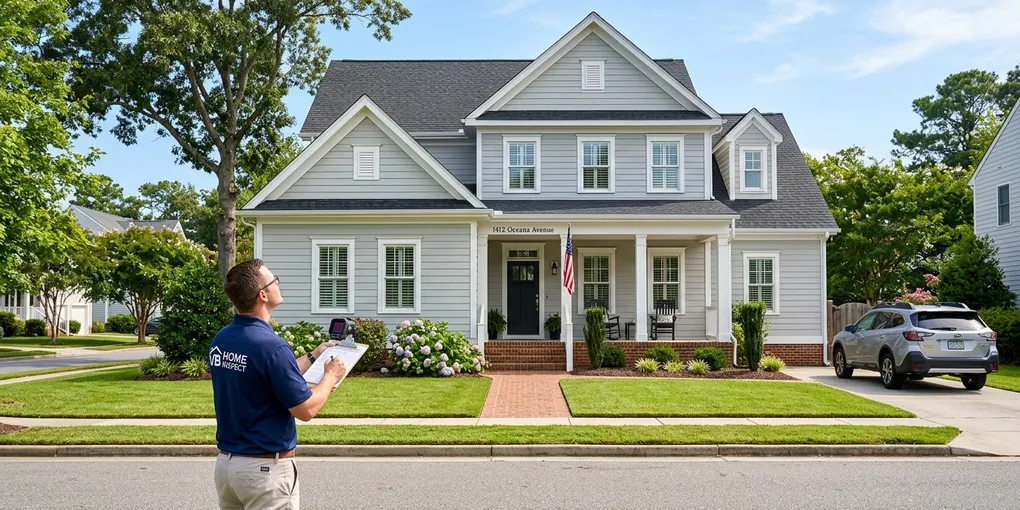
The Ultimate Guide to Spotting Roof Damage in Virginia Beach Real Estate Disclosures
Where the Chesapeake Bay meets the vast Atlantic Ocean, Virginia Beach presents a quintessential coastal lifestyle. From the historic coastal cottages and oceanfront manors of the North End and Bay Colony to the breezy waterfront homes of Chic’s Beach (Chesapeake Beach) and the expansive family neighborhoods of Great Neck and Kempsville, Virginia Beach is one of the premier coastal markets in the Mid-Atlantic.
However, behind the sandy dunes and idyllic maritime views lies a relentless, punishing environmental reality: Virginia Beach’s coastal environment inflicts severe, continuous degradation on residential roofs.
Situated at the southern tip of the Chesapeake Bay, Virginia Beach is exposed to intense coastal weather systems, including Atlantic hurricanes, gale-force winter Nor’easters, salt-fog aerosol corrosion, and high summer humidity. Because many coastal homes feature complex multi-pitch rooflines, coastal metal accents, or cedar shakes, severe moisture intrusion and framing decay frequently remain hidden beneath an outwardly intact surface.
Local real estate attorneys and buyer’s brokers regularly encounter homebuyers face staggering out-of-pocket repair bills because they misunderstood Virginia’s strict caveat emptor disclosure framework. In this comprehensive guide, we dissect the mechanics of coastal roof deterioration in Virginia Beach, break down the Virginia Residential Property Disclosure Act, and provide the legal strategies you need to safeguard your investment.
The Engineering of Coastal Roof Degradation in Virginia Beach
To evaluate a property in Virginia Beach accurately, you must understand how ocean proximity and regional meteorological forces attack roofing materials.
Salt-Aerosol Corrosion and Fastener Failure
Properties located within three to five miles of the Atlantic Ocean or the Chesapeake Bay operate in an aggressive marine atmospheric zone:
- Salt-Spray Aerosol Deposition: Coastal onshore winds carry microscopic droplets of saltwater that settle continuously on roof surfaces, valleys, and vents.
- Fastener Rust and Nail Pops: Standard galvanized roofing nails are particularly vulnerable to coastal salt spray. As nails corrode and lose structural grip within the plywood decking, coastal wind uplift causes “nail pops” that puncture shingle tabs from underneath or allow entire shingle strips to blow away.
- Flashing and Valley Deterioration: Galvanized steel drip edges, step flashing along siding, and metal valley pans corrode and develop microscopic rust pinholes. Water bypasses the flashing seams and flows directly into wall studs and soffit rafters.
Atlantic Nor’easters, Hurricanes, and Wind-Driven Rain
Virginia Beach is directly exposed to tropical storms pushing up from the Carolinas and brutal cold-season Nor’easters:
- Wind Uplift and Creasing: Sustained coastal winds of 45 to 65 mph generate substantial negative pressure across roof ridges and rakes. High winds break the thermal adhesive bond between shingles, repeatedly lifting the tabs and creasing the fiberglass mat.
- Horizontal Wind-Driven Rain: During severe storms, ocean rain does not fall vertically; it strikes buildings horizontally. Gale-force winds drive moisture upwards under shingle laps, through unbaffled ridge vents, and behind chimney counter-flashing.
Coastal Humidity, Tree Cover, and Algae Colonization
Neighborhoods like Bay Colony and Great Neck feature dense maritime canopies of loblolly pines, live oaks, and sweetgums:
- Pine Straw Debris Dams: Fallen pine needles accumulate in roof valleys and behind chimney saddles, trapping moisture and releasing organic acids that break down the protective ceramic granules on asphalt shingles.
- Algae and Moss Growth: Constant coastal humidity combined with tree shade encourages the growth of Gloeocapsa magma (black algae) and moss, which hold water against the shingles and cause premature rotting of the organic wood decking beneath.
Tired of manually reading 200-page disclosures?
Let DisclosurePro AI scan your documents for hidden termite damage, structural issues, and unpermitted work in 10 seconds. Try it free today.
Virginia Real Estate Disclosure Laws: The “Buyer Beware” Doctrine
Virginia is one of the strictest caveat emptor (“let the buyer beware”) states in the country. Understanding how the law operates is vital for any prospective homebuyer.
The Virginia Residential Property Disclosure Act
Governed by Virginia Code § 55.1-700 et seq., the Virginia Residential Property Disclosure Statement does not require sellers to provide a detailed checklist of property conditions:
- No Affirmative Seller Representations: In Virginia, the standard disclosure form explicitly advises the buyer that the owner makes no representations or warranties as to the physical condition of the property, including the roof, structural components, or water intrusion history.
- The Buyer’s Affirmative Burden: The statute explicitly warns buyers that they must inspect the property themselves, conduct necessary due diligence, and verify all aspects of the home’s condition.
The Fraud and Active Concealment Exception
While Virginia sellers are not required to complete a condition checklist, they are strictly prohibited from committing fraud or active concealment:
- If a seller has actual knowledge of a serious latent defect—such as an active roof leak that is rotting structural rafters—and intentionally conceals it by painting over water-damaged ceilings or lying in response to a direct question, the buyer may have a legal claim for fraudulent misrepresentation.
- However, if the seller merely remains silent and answers “No representation,” Virginia courts will uphold caveat emptor, leaving the buyer with zero legal recourse.
Standard Real Estate Information Network (REIN) Addenda
In the Hampton Roads market, standard contracts through the Real Estate Information Network (REIN) provide specific mechanisms:
- Standard REIN purchase agreements typically include a Home Inspection Contingency, which grants the buyer a defined period (usually 7 to 14 days) to conduct inspections and request repairs or credits.
- If the seller provided past repair invoices or insurance claim details, buyers must examine whether the scope of work was a complete reroof or simply an inexpensive, temporary tar patch.
Evasive Phrasing in Virginia Beach Transactions
Because sellers make no formal warranties, watch out for these verbal or written statements:
- “Roof inspected after recent tropical storm; no missing shingles” — Often means the seller looked up from the driveway and did not see bare decking, ignoring the fact that salt air has corroded fasteners and shingles are detached.
- “Standing seam metal roof is maintenance-free” — A dangerous myth. While metal panels resist wind, exposed neoprene fastener washers degrade under coastal UV rays, and salt air corrodes metal transitions if not coated with marine-grade primers.
- “Prior leak above garage repaired by contractor” — Check whether the contractor was a licensed Virginia Class A roofing professional or an unlicensed handyman who smeared roofing cement over flashing.
- “Seller makes no representations regarding roof age” — A contractual signal that the roof is likely at or past the end of its useful lifespan.
The Manual Review Problem: Navigating the REIN Inspection Contingency
Under a standard REIN contract in Virginia Beach, a buyer operates within a strict 7-to-14-day Home Inspection Contingency period.
During this narrow window, the homebuyer must evaluate:
- The Virginia Residential Property Disclosure Statement acknowledgments.
- The 50-to-70-page general home inspection report.
- City of Virginia Beach Planning and Permits database records to check if building permits were pulled and final inspections completed for past reroofs.
- Comprehensive Loss Underwriting Exchange (C.L.U.E.) reports detailing past wind and hurricane insurance claims.
- Invoices, wind warranty documents, and contractor licenses.
General home inspectors in coastal Virginia frequently include protective disclaimers: “Due to coastal wind conditions and steep roof pitch, roof inspected from ground level with drone or binoculars.” Drones cannot detect spongy plywood decking, hidden nail pops beneath shingle tabs, or rotted rafter tails in unventilated coastal attics. If a buyer fails to catch evasive answers and does not schedule a dedicated inspection by a licensed roofing contractor before the contingency deadline, they assume 100% of the financial risk.
Financial Impact: A Real-World North End Coastal Cottage Case Study
To see how an overlooked roof issue can lead to catastrophic financial losses, consider this realistic scenario from Virginia Beach’s North End.
The Purchase
Brian and Emily purchased a 1974 cedar-sided coastal cottage three blocks from the Atlantic Ocean on 68th Street for $795,000. The home offered classic coastal charm, exposed wood ceilings, and an architectural asphalt shingle roof.
Because Virginia is a caveat emptor state, the seller provided the standard Virginia Residential Property Disclosure Statement indicating “No representations.” When asked informally about the roof, the listing agent provided an invoice from 2022 for a “Roof tune-up and valley reseal.” The general home inspector used a drone, noting: “Roof shingles appear uniform; some granule loss consistent with coastal exposure.” Brian and Emily removed their inspection contingency and closed on the purchase.
The October Nor’easter
Seven months later, a potent October Nor’easter stalled off Cape Henry, battering the North End with 5.2 inches of torrential wind-driven rain and sustained 55 mph gusts for nearly three days.
Water began weeping through the tongue-and-groove cedar ceiling in the living room and dripping down the walls of the upstairs guest bedroom. An emergency inspection by a licensed Virginia Class A roofing contractor revealed catastrophic hidden damage:
- The roof was over 22 years old and had reached the end of its useful life years prior.
- The seller’s “2022 tune-up” was a cosmetic application of silicone sealant over heavily rusted, salt-corroded galvanized valley metal that was completely rotted through.
- Decades of coastal salt-fog exposure had rusted the galvanized roofing nails to the point of structural failure; over 60% of the shingle fasteners had rusted into dust, causing shingle tabs to lift in the gale.
- Water intrusion had rotted out 320 square feet of tongue-and-groove pine roof decking, destroyed the insulation in two exterior wall cavities, and bred toxic black mold across the attic rafters.
The Financial Devastation
Because Virginia law enforces caveat emptor and the seller made no affirmative written warranties on condition, legal recourse was unavailable. Brian and Emily were forced to pay for the complete restoration out-of-pocket:
| Expense Item | Cost |
|---|---|
| Complete tear-off of failing shingles and salt-corroded fasteners down to rafters | $5,800 |
| Replacement of rotted tongue-and-groove pine decking with 5/8“ CDX exterior plywood | $5,400 |
| Sistering and structural reinforcement of compromised coastal roof rafters | $6,800 |
| Installation of high-temperature Ice & Water Shield across 100% of the roof deck | $3,600 |
| Class 4 Impact-Resistant, 130-mph High-Wind Architectural Shingle installation | $15,200 |
| Marine-grade stainless steel valley pans, drip edge, and custom lead chimney flashing | $4,400 |
| Mold remediation, antimicrobial fogging, and replacement of attic insulation | $4,800 |
| Interior tongue-and-groove cedar ceiling restoration and refinishing | $4,200 |
| City of Virginia Beach residential building permits and inspection fees | $520 |
| Total Devastation | $50,720 |
Frequently Asked Questions about Roof Issues in Virginia Beach
1. Does a home seller in Virginia have to disclose roof leaks?
No. Virginia is a caveat emptor (“buyer beware”) state. Under the Virginia Residential Property Disclosure Act, sellers make no representations or warranties regarding the condition of the roof or structural components. The burden rests entirely on the buyer to perform inspections and due diligence, unless the seller actively conceals a defect through fraudulent misrepresentation.
2. How long do asphalt shingles last in coastal Virginia Beach?
While architectural shingles are rated for 30 years in temperate inland climates, they typically last only 15 to 20 years in Virginia Beach. Intense coastal UV rays, salt air corrosion of galvanized fasteners, high humidity, and repeated hurricane and Nor’easter wind uplift substantially shorten their effective lifespan.
3. What type of fasteners should be used on a Virginia Beach coastal roof?
Due to salt spray corrosion within coastal environments, standard electro-galvanized roofing nails corrode prematurely. Reputable roofing contractors in coastal Virginia Beach recommend hot-dipped galvanized or stainless steel roofing fasteners, which provide superior corrosion resistance and prevent nails from rusting away and allowing shingles to blow off.
4. What is the difference between a hurricane deductible and a standard deductible in Virginia?
Most homeowner insurance policies in coastal Virginia Beach include a separate named storm or hurricane deductible, typically calculated as a percentage of the home’s insured value (usually 1% to 5%) rather than a flat dollar amount. For an $800,000 home with a 2% hurricane deductible, the homeowner must pay the first $16,000 out-of-pocket for roof damage caused by a named tropical storm or hurricane before insurance coverage begins.