
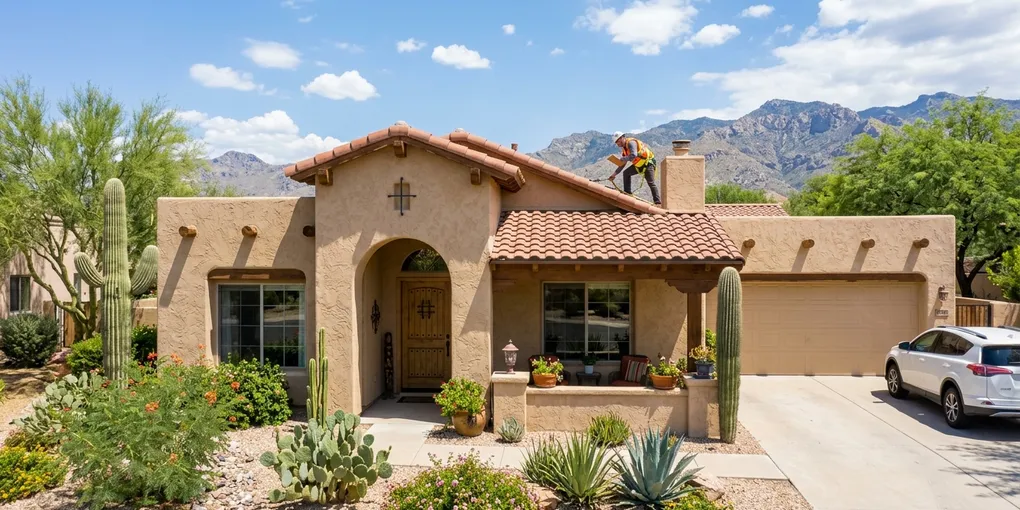
The Ultimate Guide to Spotting Roof Damage in Tucson Real Estate Disclosures
Nestled against the dramatic peaks of the Santa Catalina, Rincon, and Tucson Mountains, the Old Pueblo offers a distinctive desert lifestyle. From sprawling luxury hillside estates in the Catalina Foothills and equestrian properties in Tanque Verde, to historic adobe residences in El Presidio, mid-century brick ranches in Sam Hughes, and modern family homes in Oro Valley, purchasing real estate in Tucson is a compelling investment.
Yet beneath Tucson’s scenic saguaros and breathtaking desert sunsets lies a severe structural challenge: the Sonoran Desert climate is exceptionally punishing on residential roofs, and roof degradation is frequently hidden from plain sight.
Tucson endures an extreme meteorological environment. With over 280 days of intense desert sunshine, summer temperatures routinely surge past 105°F, driving attic and roof surface temperatures above 165°F. This relentless thermal baking is punctuated by the violent summer North American Monsoon—intense convective storm systems that produce 60-mph microburst winds, blinding haboob dust storms, and flash flooding rains. Under these conditions, roofs that appear cosmetically perfect from the driveway often conceal catastrophic underlayment failure.
Local real estate attorneys and buyer’s brokers regularly see how buyers navigate buyers through high-stakes purchases where undisclosed roof decay threatened to wipe out their financial reserves. In this comprehensive guide, we examine the physics of desert roof failure, unpack Arizona statutory disclosure law under landmark legal precedent, and show you exactly how to spot evasive seller disclosures before closing.
The Engineering of Sonoran Desert Roof Breakdown in Pima County
To properly evaluate a home in Tucson, buyers must understand the two primary roofing systems used across Southern Arizona: pitched tile assemblies and low-slope flat roofs.
The Clay and Concrete Tile Deception: Intact Tiles, Cooked Underlayment
Across master-planned communities and custom builds in Tucson, barrel clay and flat concrete tile roofs are the predominant standard. While sellers routinely advertise that “tile roofs last 50 years,” this statement is dangerously misleading:
- Tiles Are Not Waterproof: Concrete and clay tiles serve as a heavy-duty sun and impact shield; they are water-shedding, not waterproof. Rainwater naturally penetrates between tile interlocks and drains down the waterproof membrane beneath.
- The “Potato Chip” Effect: Beneath the tile lies the true waterproofing barrier—traditionally standard 30-pound asphalt-saturated organic felt. In Tucson’s extreme climate, continuous 165°F roof temperatures evaporate volatile petroleum oils from the felt. Within 15 to 20 years, the felt calcifies, turning as brittle as a potato chip.
- Microburst Wind and Water Driving: When summer monsoons unleash horizontal wind-driven rain, water is forced beneath the tile courses. If the underlying felt has cracked or rotted away, water flows directly onto the plywood or OSB roof decking, rotting trusses and ceilings.
- The “Lift and Re-Lay” Reality: Fixing a failing tile roof does not mean replacing the tiles. It requires a labor-intensive “lift and re-lay” (or “R&R”): workers carefully remove every tile, strip the disintegrating felt, install modern SBS-modified rubberized synthetic underlayment, and reinstall the original tiles. This necessary procedure routinely costs between $18,000 and $35,000.
Flat and Parapet Roofs: Elastomeric Coating Breakdown
Southwestern Territorial, Santa Fe, and mid-century modern homes in Sam Hughes and Central Tucson feature low-slope or dead-flat roofs enclosed by parapet walls:
- Acrylic Elastomeric Coating Erosion: Flat roofs—typically constructed with polyurethane foam or modified bitumen—rely on white elastomeric acrylic coatings to reflect solar radiation. In Tucson’s extreme UV index (routinely hitting 11+), elastomeric coatings wear away through chalking and oxidation. If not pressure-washed and reapplied every 4 to 6 years, solar radiation burns into the underlying membrane, creating blisters, cracks, and spongy wet insulation.
- Scupper and Downspout Backups: Desert windstorms blow sand, mesquite beans, and palo verde twigs into drainage scuppers. During a sudden monsoon deluge, clogged drains cause standing water to pool several inches deep. Flat membranes are not engineered to resist continuous hydrostatic ponding, leading to rapid seam separation.
Foothills Pack Rats and Wildlife Damage
In foothill areas like Catalina Foothills, Ventana Canyon, and Tucson Mountain foothills:
- Pack Rat (Neotoma) Nesting: Desert pack rats frequently nest beneath tile roofs and inside attic soffits. Pack rats chew through underlayment paper, electrical wiring, and plumbing vent seals, creating localized leak zones that are invisible until ceiling plaster collapses during a storm.
Tired of manually reading 200-page disclosures?
Let DisclosurePro AI scan your documents for hidden termite damage, structural issues, and unpermitted work in 10 seconds. Try it free today.
Arizona Real Estate Disclosure Laws: The SPDS and Hill v. Jones
Arizona maintains strict statutory and common-law disclosure requirements governing residential property transactions, anchored by landmark legal precedent.
Landmark Arizona Precedent: Hill v. Jones
In the landmark case Hill v. Jones, 151 Ariz. 81 (App. 1986), the Arizona Court of Appeals established the fundamental legal principle that a seller has an affirmative duty to disclose known material facts that adversely affect the value or desirability of the property, even if the buyer conducts an independent home inspection. In that case, the seller concealed past water and pest issues behind furniture; the court ruled that integration clauses and “as-is” language in purchase contracts do not protect sellers from fraudulent omission.
The Residential SPDS Form (“Spuds”)
Pursuant to Arizona Department of Real Estate (ADRE) regulations and standard Arizona Association of REALTORS® (AAR) contracts, sellers complete the Residential Seller’s Property Disclosure Statement (SPDS):
- Section 2 – Building and Safety Information: Contains an entire subsection dedicated strictly to Roof and Roof Conditions:
- What is the approximate age of the roof?
- Are you aware of any past or present roof leaks?
- Has the roof been repaired, coated, or replaced during your ownership?
- Are there any transferable roof warranties, and who issued them?
- Are you aware of any interior ceiling water stains, damage, or repairs?
The “Actual Knowledge” Escape Route
While Hill v. Jones sets a high bar, sellers often attempt to shield themselves behind claims of ignorance:
- Out-of-state investors, corporate LLC flippers, or heirs of estates frequently write “Never lived in property; seller makes no representations” on the SPDS.
- Sellers often claim that because they paid a handyman $300 to caulk a few cracked tiles or apply elastomeric paint to a leak spot, the defect was “cured,” allowing them to falsely check “No known leaks.”
- If you discover a concealed roof failure after escrow closes, recovering damages requires initiating an AAR mediation, arbitration, or formal lawsuit in Pima County Superior Court—demanding thousands in upfront legal fees.
Evasive Phrasing in Tucson Seller Disclosures
When examining the SPDS for a Tucson home, watch out for these subtle phrasing tactics:
- “Tile roof original; inspected periodically” — Masks that the tile underlayment is 22 years old and completely deteriorated.
- “Routine elastomeric maintenance coat rolled in 2024” — Often conceals that the seller did not pressure-wash or repair saturated underlying foam before painting over it.
- “Repaired minor storm tile slippage in 2023” — Conceals that monsoon winds ripped tiles loose and water soaked attic insulation.
- “Active roof warranty in place” — Reassuring on the surface, but most commercial roof warranties in Arizona require a formal inspection, transfer application, and substantial transfer fee within 30 days of closing, or the warranty is voided.
The Manual Review Problem: Racing the 10-Day Inspection Window
Under Section 6a of the standard Arizona Association of REALTORS® Residential Purchase Contract, buyers have an Inspection Period of only 10 calendar days from contract ratification (unless explicitly negotiated otherwise).
During this 10-day window, a buyer must thoroughly review and reconcile:
- The 8-page statutory SPDS disclosure document.
- The 60-to-90-page comprehensive home inspection report.
- The property’s C.L.U.E. (Comprehensive Loss Underwriting Exchange) Report (which lists all homeowner’s insurance claims filed on the property over the prior 5 to 7 years).
- City of Tucson Planning & Development Services or Pima County Development Services permit records to verify whether reroofing permits were pulled and passed.
- HOA CC&Rs, architectural guidelines, and roof color/material restrictions (especially strict in foothill communities).
Crucially, standard home inspectors in Arizona are governed by the Arizona State Board of Technical Registration (BTR) standards of practice. Inspectors are not required to walk on tile roofs due to the high risk of breaking tiles, and they are prohibited from lifting tiles to inspect underlying felt. An inspector’s report typically reads: “Tile roof inspected from ground level with binoculars; underlayment condition cannot be determined.” If an unwary buyer does not immediately schedule a licensed Arizona C-42 roofing contractor to lift sample tiles, they walk directly into a multi-thousand-dollar trap.
Financial Impact: A Real-World Catalina Foothills Case Study
To understand the catastrophic financial risks of missing roof red flags in Tucson, examine this realistic scenario from a purchase in the Catalina Foothills.
The Acquisition
Nathan and Rebecca purchased a 3,100-square-foot custom Southwestern-style home in the Catalina Foothills for $895,000. Built in 2002, the residence featured vaulted tongue-and-groove cedar ceilings, sweeping city views, and authentic Spanish barrel tile roofing.
On the Arizona SPDS, the seller checked “No” to active roof leaks, writing: “Roof serviced in 2023 for routine tile alignment; no active leaks during seller’s ownership.” The general home inspector inspected the roof from eaves and ladder perimeters, noting: “Barrel tiles appear intact; no cracked tiles observed; no ceiling moisture detected using pinless moisture meter.” Reassured, Nathan and Rebecca waived further roof inspections and finalized the purchase.
The July Monsoon Disaster
In late July, a severe Sonoran Desert monsoon thunderstorm struck the Santa Catalina foothills, dumping 2.4 inches of wind-driven rain in less than an hour, accompanied by 55-mph microburst gusts.
Within 45 minutes, water began streaming down the exposed cedar beams in the living room and dripping through the high ceiling of the master bedroom. Nathan climbed into the low-clearance attic space and found water gushing across ceiling joists.
A licensed Arizona roofing contractor arrived the following morning and performed a destructive test inspection:
- The 2002 roof had original 30# organic felt underlayment that had completely calcified, disintegrated, and shredded across all west- and south-facing roof slopes.
- The seller’s “2023 tile alignment” had actually been a cosmetic repair performed by an unlicensed handyman who applied roof cement over rotted underlayment beneath two primary valleys.
- Desert pack rats had chewed multiple nesting passages through the brittle underlayment along the eaves, allowing wind-driven rain to funnel directly into the wall framing.
- Water had saturated ceiling insulation, ruining custom cedar woodwork and generating widespread toxic mold behind drywall walls.
The Financial Devastation
Because the seller claimed they had relied on the handyman’s assurances, proving intentional fraud in court would have required months of costly litigation. Nathan and Rebecca paid for structural restoration out-of-pocket:
| Expense Item | Cost |
|---|---|
| Complete lift, cleaning, and stacking of existing Spanish clay tiles | $19,800 |
| Replacement of water-damaged CDX plywood roof decking and fascia trim | $5,600 |
| Installation of premium dual-layer high-temp SBS self-adhering modified underlayment | $8,400 |
| Reinstallation of clay tiles with code-mandated mechanical fasteners and foam adhesives | $4,200 |
| Professional attic mold remediation, HEPA fogging, and pack rat exclusion screening | $4,800 |
| Custom tongue-and-groove cedar ceiling refinishing, drywall replacement, and painting | $3,900 |
| Pima County residential roofing permits and municipal inspection fees | $900 |
| Total Devastation | $47,600 |
Frequently Asked Questions about Roof Issues in Tucson
1. How long does tile roof underlayment last in the Tucson desert?
While concrete and clay tiles can last 50 to 100 years, standard organic asphalt felt underlayment in Tucson typically lasts only 15 to 20 years. The intense thermal heat from 110°F summer days bakes the underlayment until it becomes brittle and cracks. When replacing underlayment, today’s industry gold standard is a high-temperature self-adhering SBS-modified synthetic underlayment, which can last 30+ years in the Sonoran Desert.
2. Can I inspect a tile roof myself before buying a Tucson home?
It is strongly discouraged. Walking on clay barrel or concrete tiles requires specialized stepping techniques (stepping only on the lower third of overlapping tiles). Walking incorrectly can easily crack brittle tiles, breaking the fragile underlayment beneath and causing thousands of dollars in new damage. Always hire a licensed Arizona Registrar of Contractors (ROC) C-42 roofing specialist.
3. What does an elastomeric roof coating do on a Tucson flat roof?
An elastomeric roof coating is an elastic, rubber-like coating that reflects solar heat and shields the underlying foam or asphalt membrane from intense ultraviolet degradation. In Tucson, acrylic elastomeric coatings must be recoated every 4 to 6 years, while 100% high-solids silicone coatings can last 10 to 15 years. A fresh coating without proper preparation or over wet foam will peel and blister within months.
4. What is a C.L.U.E. report, and why is it essential for Tucson roof due diligence?
A Comprehensive Loss Underwriting Exchange (C.L.U.E.) report tracks insurance claims filed on a residential property over the past 5 to 7 years. In Tucson, where intense monsoon hail and wind events occur regularly, a C.L.U.E. report will reveal whether the seller previously filed an insurance claim for roof storm damage. If a previous claim was paid out but the seller kept the insurance cash without replacing the roof, the buyer’s insurance company may exclude the roof from coverage or refuse to insure the property entirely.