
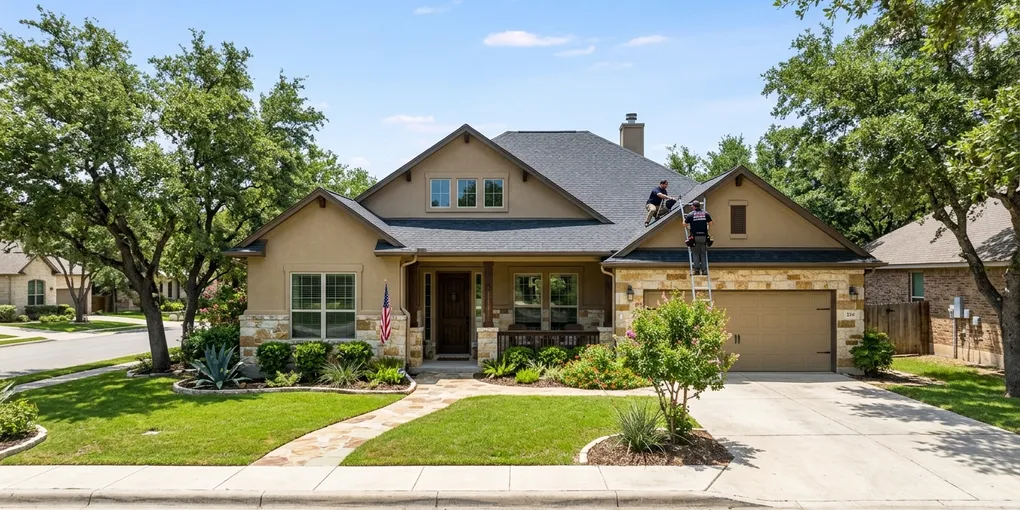
The Ultimate Guide to Spotting Roof Damage in San Antonio Real Estate Disclosures
San Antonio boasts one of the most culturally vibrant and rapidly growing real estate markets in the United States. From grand historic estates in King William and Monte Vista and charming cottages in Alamo Heights to modern family homes in Stone Oak and the sprawling Hill Country communities of Helotes, buyers are drawn by the city’s rich history and lifestyle. Yet beneath the limestone facades, shaded oak trees, and inviting front porches lies a serious structural risk that costs local homebuyers millions of dollars every year: undisclosed roof damage.
San Antonio sits directly in the path of some of the most violent weather patterns in the country. Situated at the junction of South Texas heat and Hill Country terrain, the city frequently experiences extreme convective hailstorms, flash-flood rainfalls, and triple-digit summer heatwaves that push rooftop temperatures past 160°F. When severe hail strikes or scorching heat breaks down roofing materials, an aging roof can deteriorate rapidly, allowing driving rain to flood attics and destroy interior drywall.
As an experienced Texas real estate attorney and active San Antonio real estate broker, I routinely guide buyers through complex transactions. Time and again, I see buyers fall in love with cosmetic interior upgrades while overlooking ambiguous notes in the Texas Seller’s Disclosure Notice. In this comprehensive guide, we will examine how San Antonio weather destroys roofs, analyze Texas disclosure statutes, and show you how to spot dangerous red flags before your option period expires.
The Elements Destroying San Antonio Roofs
To accurately evaluate a roof in San Antonio, a homebuyer must understand the unique combination of climate factors and housing styles across Bexar County.
The Hail Alley Hazard: Micro-Fractures and Granule Loss
San Antonio is situated in the infamous “Hail Alley” corridor of Central and South Texas. Spring cold fronts colliding with humid Gulf air regularly spawn severe supercells producing golf-ball to baseball-sized hail:
- Fiberglass Mat Fractures: Hail impacts rarely puncture completely through a shingle. Instead, the kinetic impact pulverizes the protective mineral granules into the asphalt and fractures the internal fiberglass mat.
- Delayed Water Infiltration: Immediately after a hailstorm, a roof may not leak. But without mineral granules, the exposed asphalt quickly degrades under ultraviolet light. Within 6 to 12 months, the bruised asphalt cracks open, allowing subsequent rains to penetrate directly into the decking.
- Metal Valleys and Flashing Dents: Hail impacts dent and bend copper or galvanized steel valley flashings, pulling them away from adjacent shingles and creating hidden channels for water intrusion.
South Texas Heat and Thermal Shock
San Antonio routinely endures prolonged summer stretches with temperatures exceeding 100°F:
- Asphalt Volatilization: Rooftop surface temperatures on dark architectural shingles easily reach 150°F to 170°F. This extreme heat bakes out essential petroleum plasticizers, causing shingles to lose flexibility, curl, and blister.
- Thermal Shock: When a sudden late-afternoon thunderstorm drops heavy, cold rain onto a 160°F roof, the assembly experiences extreme thermal shock. The sudden contraction cracks brittle asphalt and breaks adhesive sealant strips.
- Wind Lift: Once thermal adhesive strips lose their bond, typical 40-to-60 mph thunderstorm gusts easily lift the shingles, allowing wind-driven rain to blow beneath the courses.
Inadequate Attic Ventilation and Wood-Decay Fungi
Many older homes in historic San Antonio neighborhoods—as well as rapidly constructed suburban developments—suffer from inadequate ridge and soffit ventilation. During humid summer months, superheated, moist air becomes trapped in the attic space:
- Condensation forms on the underside of plywood or OSB roof decking.
- This creates an ideal environment for wood-decay fungi, which rots the structural roof sheathing and framing from the inside out while the shingles on top appear intact to an untrained eye.
Tired of manually reading 200-page disclosures?
Let DisclosurePro AI scan your documents for hidden termite damage, structural issues, and unpermitted work in 10 seconds. Try it free today.
Navigating Texas Real Estate Disclosure Laws in San Antonio
Texas statutory law establishes clear disclosure obligations, but understanding how sellers use ambiguous phrasing to protect themselves is vital for homebuyer protection.
Texas Property Code Section 5.008
Under Section 5.008 of the Texas Property Code, sellers of single-family residential properties must deliver the standardized Seller’s Disclosure Notice (using TREC form OP-H or Texas REALTORS® form TXR-1406):
- Section 4: Specifically requires the seller to disclose the Type of Roof, the Approximate Age of the Roof, and whether there are any known Defects or Malfunctions in the roof, ceilings, or chimney.
- Section 7: Demands disclosure of any Unresolved Insurance Claims or previous claims filed for property damage (such as wind or hail claims).
- Water Penetration: Inquires whether the home has experienced past roof leaks, ceiling stains, or moisture problems.
The “Pocketed Insurance Claim” Red Flag
One of the most widespread issues in San Antonio real estate involves insurance claims following major hailstorms: A homeowner files a claim after a severe hailstorm. An insurance adjuster inspects the property, determines the roof is a total loss, and cuts an insurance settlement check for $25,000. Rather than replacing the roof, the seller spends $1,000 on minor cosmetic shingle repairs and pockets the remaining $24,000.
When putting the home on the market, the seller checks “No” to active leaks, knowing that the roof has not yet leaked into the living room. However, the insurance carrier has already officially recorded the roof as totaled in insurance databases (such as C.L.U.E.).
If you purchase this home, you will face severe problems:
- When you apply for homeowner’s insurance, the carrier may exclude the roof from coverage or demand an immediate complete replacement as a condition of issuing a policy.
- If another storm hits, any claim you file will be denied because the prior damage was never officially repaired.
Deceptive Language in San Antonio Disclosures
Sellers and investors frequently craft ambiguous statements on the Seller’s Disclosure Notice to dodge liability:
- “Roof inspected after 2023 spring storm; minor maintenance performed” (concealing that an adjuster totaled the roof).
- “No known leaks during seller’s ownership” (technically true during dry summer months, but hiding failing underlayment).
- “Architectural composite shingle; age unknown but appears in good condition” (deflecting inquiry from an 18-year-old shingle system).
- “Seller is an investor/estate and has never occupied the property” (used to check ‘Unknown’ across all questions).
The Manual Review Problem: Racing the Texas Option Period
In Texas real estate, buyers typically negotiate a contractual Option Period (under Paragraph 23 of the standard TREC One-to-Four Family Residential Contract). In San Antonio’s competitive neighborhoods, this option period usually lasts only 5 to 7 days, during which the buyer has the unrestricted right to terminate the contract.
During this compressed timeframe, buyers must review an overwhelming amount of documentation:
- The Texas Seller’s Disclosure Notice.
- The Comprehensive Loss Underwriting Exchange (C.L.U.E.) report.
- Municipal permit records from the City of San Antonio Development Services Department.
- Professional home inspection, termite (WDI), and foundation elevation reports.
- HOA restrictive covenants, bylaws, and financial statements.
In the rush to negotiate repairs before the option deadline expires at 5:00 PM, buyers frequently miss critical red flags. For example, a buyer might notice that the seller listed the roof age as “unknown,” but fail to notice that the home inspector noted extensive hail bruising across the rear roof slope, or miss an unsettled $20,000 storm claim listed on page 3 of the C.L.U.E. report.
Manually cross-referencing these technical files under extreme time pressure leaves buyers vulnerable to catastrophic financial surprises.
A Financial Nightmare: A Real-World Alamo Heights Case Study
To see how an overlooked disclosure note can devastate a buyer, consider this true-to-life case study from a home purchase in Alamo Heights.
The Purchase
Carlos and Vanessa purchased a renovated 1950s ranch-style home in Alamo Heights for $585,000. In Section 4 of the Texas Seller’s Disclosure Notice, the seller noted: “Roof: Composition Shingle. Age: Approximately 6 years. Defects: None.” In Section 7 regarding insurance, the seller marked “No” to unresolved claims.
Carlos and Vanessa hired a general home inspector. Because the pitch of the roof was steep and the roof was wet from morning dew, the inspector inspected the roof only from the eaves with a ladder, noting that the architectural shingles appeared cosmetically intact. Relying on the 6-year age disclosure, the buyers waived their option period and closed the purchase.
The Disaster
Six months later, an intense South Texas spring convective thunderstorm dropped golf-ball-sized hail and three inches of rain across Alamo Heights.
During the storm, water began pouring through the hallway ceiling and running down the walls into the master suite. When an emergency roofing contractor accessed the roof and attic the following morning, the truth was revealed:
- The shingles were not six years old; they were sixteen years old and had been subjected to three major hailstorms.
- The previous owner had filed an insurance claim eighteen months earlier after a severe hailstorm, received a $26,000 settlement check, and hired an unlicensed handyman for $800 to caulk visible cracks, pocketing the remaining funds.
- Over fifty square feet of plywood decking was completely rotten and had collapsed under the weight of the water.
- Saturated blown-in fiberglass insulation had collapsed the hallway drywall ceiling, and toxic mold (Aspergillus) had spread across the ceiling joists.
The Financial Devastation
Because the seller technically claimed the age was “approximate” and asserted they had not personally seen interior leaks prior to closing, proving intentional fraud required lengthy litigation under the Texas Deceptive Trade Practices Act (DTPA). Carlos and Vanessa were forced to pay for full structural remediation immediately:
| Expense Item | Cost |
|---|---|
| Emergency tarping and water extraction services | $3,100 |
| Complete tear-off of saturated shingles and felt | $8,500 |
| Replacement of rotted plywood roof decking and rafter framing | $9,800 |
| Installation of Class 4 impact-resistant architectural shingles and synthetic underlayment | $15,200 |
| Attic mold remediation, insulation extraction, and antimicrobial fogging | $7,400 |
| Interior drywall replacement, ceiling re-texturing, and painting | $8,200 |
| Total Devastation | $52,200 |
Frequently Asked Questions about Roof Issues in San Antonio
1. How often do hailstorms damage roofs in San Antonio?
San Antonio experiences severe convective hailstorms almost every spring. According to meteorological data, Bexar County experiences an average of 4 to 8 hail events per year, with severe hailstorms producing damaging hail (exceeding 1 inch in diameter) every 2 to 3 years. Because hail damage is often invisible from the ground, having a certified roofing professional physically inspect the roof after any hail event is critical.
2. What are Class 4 impact-resistant shingles and are they worth it in San Antonio?
Class 4 impact-resistant shingles are specially engineered shingles tested to withstand the impact of a 2-inch steel ball dropped from 20 feet without cracking the fiberglass mat (under UL 2218 testing standards). In San Antonio, installing Class 4 shingles significantly reduces future hail damage risk and often qualifies homeowners for substantial annual discounts (up to 20% to 30%) on their homeowner’s insurance premiums.
3. Can I sue a seller in Texas under the DTPA for hiding roof damage?
Yes. Under the Texas Deceptive Trade Practices-Consumer Protection Act (DTPA) and Section 27.01 of the Texas Business and Commerce Code (Statutory Fraud in Real Estate), a seller who knowingly conceals material roof defects, hides pocketed insurance claims, or makes false statements on the Seller’s Disclosure Notice can be held liable. If the court finds the seller acted “knowingly” or “intentionally,” the buyer may be awarded treble damages (up to three times economic damages) plus attorney’s fees.
4. What is a C.L.U.E. report, and why is it essential when buying in San Antonio?
A Comprehensive Loss Underwriting Exchange (C.L.U.E.) report is a five-to-seven-year history of insurance claims filed on a property. It reveals whether prior owners filed claims for hail or wind damage, how much the insurance company paid, and whether repairs were certified. In San Antonio, always request that the seller provide a C.L.U.E. report during your option period to verify whether the seller pocketed hail claim payouts.