
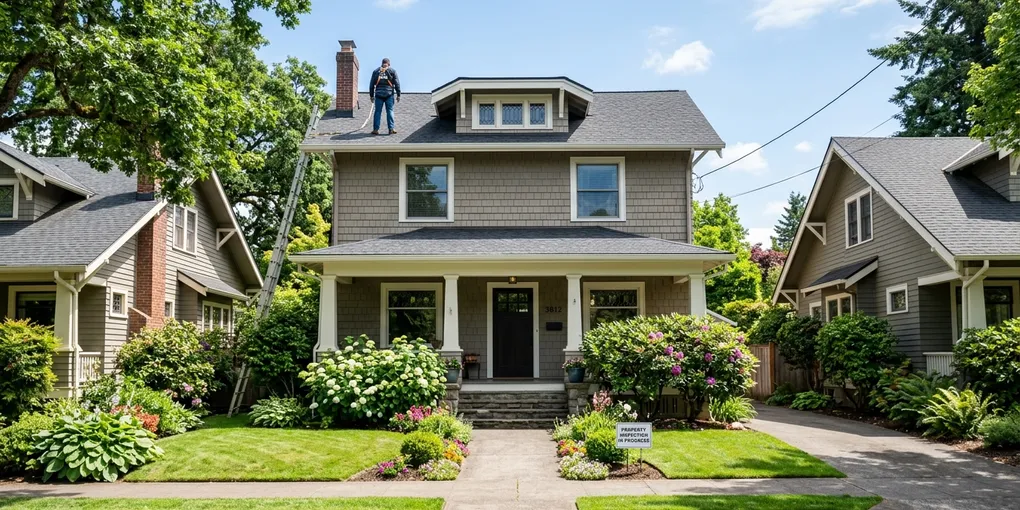
The Ultimate Guide to Spotting Roof Damage in Portland Real Estate Disclosures
Portland is renowned for its distinctive neighborhood character, environmental consciousness, and world-class architectural preservation. Nestled between the Willamette and Columbia rivers with Mount Hood standing guard on the eastern horizon, the “City of Roses” offers a remarkable collection of residential architecture. From the meticulously preserved Craftsman bungalows and Four-Squares of Hawthorne, Sunnyside, and Laurelhurst to the grand Queen Anne Victorians of Irvington and the striking mid-century modern homes nestled in the forested hills of the West Hills and Southwest Portland, the city provides homebuyers with exceptional historic beauty.
However, towering above Portland’s streets is a natural feature that defines both its lush scenery and its biggest structural challenge: massive Douglas fir trees and eight continuous months of Pacific Northwest rain.
Between October and May, Portland experiences near-constant drizzle, dense cloud cover, and saturating maritime humidity. Under these prolonged damp conditions, residential roofs rarely have an opportunity to thoroughly dry out. This persistent moisture transforms roofs into fertile ground for aggressive moss colonies, wood-decaying fungi, and chronic dry rot. When combined with historic cedar shake conversions and unpermitted repairs, overlooking vague phrasing in an Oregon seller’s disclosure can leave a homebuyer with catastrophic structural repair expenses shortly after closing.
As an Oregon real estate attorney and active Portland broker, I routinely guide buyers through complex residential transactions where an unexamined roofing red flag turns a dream home into a financial nightmare. In this comprehensive guide, we unpack the mechanics of Willamette Valley roof deterioration, examine Oregon’s statutory disclosure requirements, and expose the subtle red flags sellers use to disguise damaged roofs.
The Anatomy of Portland Roof Damage: Rain Cycles, Moss Carpets, and Cedar Conversions
Evaluating a home in Multnomah County requires understanding how the Pacific Northwest’s damp climate degrades residential roofing assemblies.
The Moss and Lichen Threat
In Portland, moss is not merely an aesthetic quirk—it is an aggressive structural destroyer:
- Mechanical Shingle Lifting: Moss spores thrive in the cool, shaded moisture of Portland’s northern roof exposures. As moss clumps expand, thick root-like structures (rhizoids) work their way underneath the edges of asphalt shingles, breaking the factory adhesive sealant strips and mechanically lifting the shingles upward.
- The Saturated Sponge Effect: Mature moss carpets absorb up to twenty times their dry weight in water. Rather than allowing rainfall to run off into gutters, moss-covered roofs hold standing water directly against shingle surfaces for weeks at a time. This continuous moisture forces water upward beneath overlapping shingles via capillary action.
- Granule Sloughing and Accelerated Decay: As winter temperatures fluctuate around the freezing mark, trapped water expands within the moss, prying protective ceramic granules off asphalt shingles and exposing the delicate fiberglass mat beneath.
The Historic Cedar Shake Problem: Hawthorne and Laurelhurst
Many of Portland’s historic Craftsman and mid-century homes originally featured Western Red Cedar shake roofs:
- Failed Asphalt Conversions: Cedar shakes were historically installed over spaced wooden boards (“skip sheathing”) to permit air circulation. When previous homeowners converted to modern asphalt shingles without tearing off the shakes, or without installing continuous 1/2-inch CDX plywood sheathing over the skip boards, the installation frequently fails. Fasteners miss the open framing, leading to loose shingles, wind blow-offs, and leaks.
- Fungal Dry Rot in Douglas Fir Decking: Persistent dampness and poor attic airflow create ideal conditions for wood-destroying fungi such as Coniophora puteana (cellar fungus) and Serpula lacrymans. These fungi decompose the structural cellulose in wooden rafters and decking boards, reducing solid timber to brittle, crumbling rot.
Douglas Fir Needle Accumulation and Gutter Dams
Portland’s urban forest of towering Douglas firs and bigleaf maples drops needles and leaves year-round:
- Needle Dams in Valleys: Pine and fir needles collect in roof valleys, behind chimney flashings, and around skylights. As debris decomposes, it forms an acidic compost that corrodes metal valley flashings and rots underlying underlayment.
- Chronic Gutter Overflow: Clogged gutters back up during autumn storms, allowing water to saturate wooden fascia boards and rot out overhanging rafter tails.
Tired of manually reading 200-page disclosures?
Let DisclosurePro AI scan your documents for hidden termite damage, structural issues, and unpermitted work in 10 seconds. Try it free today.
Navigating Oregon Real Estate Disclosure Laws in Portland
In Oregon, residential property sales are governed by clear statutory disclosure rules designed to protect buyers from undisclosed structural defects.
Oregon Revised Statutes (ORS) 105.462 to 105.490
Under ORS 105.465, sellers of residential property must complete and deliver the standardized Seller’s Property Disclosure Statement (Oregon Real Estate Agency / OREF Form 020) to prospective buyers.
Section 2 of the Oregon disclosure statement specifically interrogates the seller regarding structural components:
- Question 2A: “Roof: Age of roof, if known:”
- Question 2B: “Has the roof leaked within the last 5 years?”
- Question 2C: “Have there been any repairs to the roof within the last 5 years?”
- Question 2D: “Has the roof been replaced within the last 5 years?”
- Question 2E: “Are there any known unpermitted additions or structural modifications?”
The Buyer’s Statutory 5-Day Right of Revocation
Under ORS 105.475, the delivery of the Seller’s Property Disclosure Statement grants the buyer an invaluable legal safeguard:
- The buyer has five business days from the date the disclosure is delivered to review the document and, for any reason or no reason, revoke their offer and receive an immediate refund of their earnest money deposit.
- If a seller fails to provide the disclosure statement prior to closing, the buyer retains the absolute right to revoke the purchase agreement at any point up until closing.
Seller Duties: Actual Knowledge vs. Concealment
Under Oregon law, sellers must disclose all known material defects based on their actual knowledge.
While sellers are not required to hire an inspector to fill out the form, Oregon courts hold sellers strictly accountable for intentional misrepresentation and fraudulent concealment:
- If a seller paints over active water stains in an attic bedroom or pressure-washes a moss-covered roof right before listing to hide deteriorated shingles, that conduct constitutes actionable fraud.
- Under Oregon common law and the Oregon Unlawful Trade Practices Act, buyers injured by fraudulent real estate disclosures can sue to recover actual repair costs, punitive damages, and statutory attorney fees.
Evasive Phrasing Used by Portland Sellers
Despite Oregon’s statutory rules, sellers and flippers frequently use ambiguous language on Form 020:
- “Annual moss treatment and roof maintenance performed by specialist” (frequently disguising that high-pressure washing stripped 50% of the mineral granules).
- “Roof age estimated at 10 years” (omitting the fact that the roof was an unpermitted overlay over rotted cedar skip sheathing).
- “Minor leak around skylight curb repaired in 2023” (ignoring widespread fungal decay in the surrounding structural rafters).
- “Seller is an investor / estate representative and has never occupied the residence” (used as a pretext to check “Unknown” across all structural sections).
The Manual Review Problem: Drowning in Portland Due Diligence
Under the standard Oregon Real Estate Forms (OREF) Residential Real Estate Sale Agreement, buyers typically negotiate a professional inspection contingency period of 10 to 14 business days.
During this high-stress timeframe, prospective buyers must digest a staggering volume of complex records:
- The 5-page Oregon Seller’s Property Disclosure Statement.
- The City of Portland Bureau of Development Services (BDS) online permit history (PortlandMaps.com).
- The private home inspection report (frequently 60 to 80 pages).
- Sewer scope video inspections, radon test results, and oil tank scan reports.
- Specialized wood-destroying organism (WDO) and pest inspection reports.
Critical roof red flags are frequently buried in technical notes. For example, an inspector might write on page 46: “Observed localized fungal staining and minor moisture meter deflections on attic roof sheathing near north gable.” To an untrained buyer, “minor moisture deflection” sounds trivial. In reality, in Portland’s sodden climate, that fungal staining indicates active dry rot that has compromised the structural integrity of the roof framing.
Financial Impact: A Real-World Hawthorne Craftsman Case Study
To see how disastrous an unvetted roof disclosure can be in Portland, consider this realistic scenario from a historic home acquisition in Hawthorne.
The Acquisition
Sam and Nina purchased a 1912 Craftsman bungalow in Portland’s Hawthorne district for $745,000. On the Oregon Seller’s Property Disclosure Statement, the seller answered “No” to active roof leaks and wrote under Question 2A: “New architectural roof installed in 2020; moss treatment completed annually.”
Their private home inspector performed a general inspection. Because heavy rain made the steep roof slippery, the inspector viewed the shingles from a ladder at the eave and via drone photography, noting: “Roof shingles appear uniform and in satisfactory condition; no active water staining observed in finished attic bedroom.” Reassured by the seller’s statement that the roof was only six years old, Sam and Nina waived their inspection contingency and finalized the purchase.
The Disaster
The following December, Portland was hit by a prolonged winter atmospheric river event that delivered 6.5 inches of rain over three days, accompanied by 50 mph wind gusts.
Water began trickling through the ceiling plaster in the dining room and pooling around the living room fireplace. Sam called a reputable Multnomah County roofing and structural restoration contractor. When the crew inspected the attic and pulled up several shingle courses, they uncovered catastrophic concealed damage:
- The 2020 roof was an unpermitted illegal overlay. The contractor had nailed modern architectural shingles directly over 110-year-old cedar shake skip sheathing without installing continuous solid CDX plywood decking.
- The cedar shakes underneath had absorbed decades of moisture, forming a saturated sponge that caused widespread fungal dry rot (Coniophora puteana) in the structural Douglas fir rafters.
- The seller had aggressively pressure-washed the shingles in 2024 to remove heavy moss before selling, stripping 60% of the protective ceramic granules and causing micro-fissures across the ridge caps.
- Step flashing along the brick chimney was missing entirely; the previous contractor had simply troweled black roofing cement over the joint, which had cracked under thermal expansion.
- Trapped moisture had caused severe mold contamination across the attic insulation and warped the finished hardwood ceiling joists below.
The Financial Devastation
Because the seller was an out-of-state investor LLC that dissolved shortly after the transaction, legal recovery was impractical. Sam and Nina had to pay out-of-pocket for complete structural restoration:
| Expense Item | Cost |
|---|---|
| Emergency roof tarping and industrial water extraction | $3,200 |
| Hazardous tear-off and disposal of asphalt shingles and rotted cedar skip sheathing | $14,500 |
| Structural rafter replacement, timber sistering, and ridge beam reinforcement | $18,200 |
| Installation of 1/2-inch CDX plywood sheathing and high-temperature ice barrier | $10,800 |
| Installation of 50-year algae-resistant architectural shingles | $17,400 |
| Custom lead chimney step flashing and brick masonry tuckpointing | $4,600 |
| Dining room historic lathe-and-plaster ceiling restoration, insulation, and repainting | $11,200 |
| City of Portland Bureau of Development Services (BDS) permits and engineering fees | $1,800 |
| Total Devastation | $81,700 |
Frequently Asked Questions about Roof Issues in Portland
1. Does pressure washing moss off a Portland roof void the shingle warranty?
Yes. Major asphalt shingle manufacturers (including GAF, CertainTeed, and Malarkey) explicitly state that pressure washing voids their product warranties. The high-pressure water stream dislodges the protective mineral granules that shield the asphalt core from UV rays and rain, cutting the roof’s lifespan in half. Safe moss management in Portland requires gentle manual brushing and the application of an EPA-approved zinc or copper-based moss retardant.
2. Can you put a new asphalt roof over an old cedar shake roof in Oregon?
No. Under the Oregon Residential Specialty Code (ORSC), asphalt shingles must be installed on a continuous, solid nailing deck (such as plywood or OSB). Historic cedar shake roofs were typically installed over spaced 1x4 or 1x6 skip sheathing. Nailing asphalt shingles directly over cedar shakes or open skip sheathing violates building codes, leads to wind blow-offs, and voids all manufacturer warranties.
3. What does Oregon law require sellers to disclose about past roof leaks?
Under ORS 105.465, sellers must disclose all roof leaks and repairs that occurred within the past five years. If a seller knows the roof leaked during a winter rainstorm and fails to disclose it on Form 020, or conceals the leak with cosmetic interior paint, the seller can be held liable for fraudulent misrepresentation.
4. What is the typical lifespan of an architectural asphalt shingle roof in Portland?
In the Pacific Northwest’s damp, moss-heavy climate, standard architectural shingles typically last 18 to 22 years. Standard 3-tab shingles frequently fail in as few as 12 to 15 years, particularly on heavily shaded northern roof slopes or beneath dense Douglas fir canopies.