
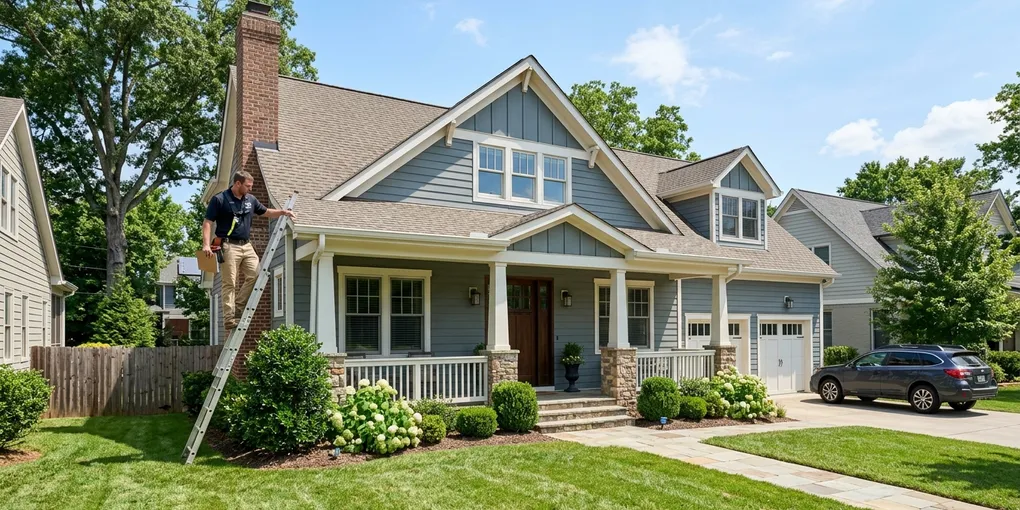
The Ultimate Guide to Spotting Roof Damage in Nashville Real Estate Disclosures
Music City is one of the most vibrant and rapidly expanding real estate markets in the United States. From historic 1920s Craftsman bungalows in East Nashville and 12 South, to grand Victorian restorations in Germantown, stately custom estates in Belle Meade and Green Hills, and trendy modern “tall-and-skinny” homes in The Nations and Sylvan Park, purchasing a home in Davidson County represents an exciting lifestyle choice and a prime financial investment.
Yet behind Nashville’s wraparound front porches and modern architectural lines lies a frequent and expensive danger: Middle Tennessee weather is exceptionally destructive to residential roofs, and roof damage is frequently hidden behind deceptive seller disclosures.
Nashville sits squarely in the volatile Dixie Alley meteorological corridor. The region experiences frequent severe supercell thunderstorms, violent tornadoes, straight-line derecho winds exceeding 70 mph, and destructive spring hail storms dropping golf-ball-sized hail. In the summer, oppressive heat and 90% humidity cultivate voracious cyanobacteria (Gloeocapsa magma) that feast on shingle limestone filler, while winter brings rapid freeze-thaw cycles that buckle valley flashings. Under these punishing conditions, roofs often suffer catastrophic, hidden structural damage.
As a practicing Tennessee real estate attorney and active Nashville broker, I routinely represent buyers who face unexpected five-figure roof replacement costs because they relied on superficial inspection summaries and failed to identify crucial red flags in the seller’s disclosure paperwork. In this comprehensive guide, we dissect the mechanics of Nashville roof breakdown, analyze the Tennessee Residential Property Condition Disclosure Act under Tenn. Code Ann. § 66-5-201, and reveal how to spot evasive seller tactics before closing.
The Anatomy of Middle Tennessee Roof Degradation: Hail, Dixie Alley Wind, and Algae Decay
Understanding how residential roofs deteriorate in Davidson County requires examining the local building stock and the severe weather patterns unique to Middle Tennessee.
Hail Impact: Hidden Fiberglass Mat Fractures
Nashville regularly experiences severe spring hail storms. While large hail creates obvious cosmetic dings on metal gutters, the most dangerous damage is hidden on asphalt shingles:
- Inner Mat Bruising: When large hailstones strike architectural shingles, they smash the protective outer layer of ceramic granules and fracture the underlying fiberglass mat. While the shingle may look relatively intact from the yard, the fractured fiberglass mat allows rainwater to seep through into the underlayment.
- Granule Loss and Accelerated UV Aging: Hail dislodges granules, exposing the raw black asphalt substrate directly to intense summer UV rays. Within one or two seasons, the sun bakes and cracks the exposed asphalt, creating hundreds of leak points across the roof deck.
- The “Pocketed Claim” Epidemic: In Nashville, a widespread disclosure trap ensnares unwary buyers: after a major storm, a homeowner files an insurance claim and receives an insurance payout of $15,000 to $25,000 to replace a hail-damaged roof. Instead of replacing the roof, the owner spends $500 on a temporary caulk patch, pockets the remaining cash, and lists the home for sale without disclosing the prior claim. When the buyer purchases the property, their insurer may review the C.L.U.E. database and refuse to insure the roof or exclude all future hail damage!
High Humidity, Heat, and Gloeocapsa Magma Algae
Nashville’s sultry, humid summers create the perfect breeding ground for airborne cyanobacteria and algae:
- Limestone Consumption: The characteristic black streaks seen on north-facing Nashville roofs are colonies of Gloeocapsa magma. Modern asphalt shingles use crushed limestone as a cost-effective filler. This algae feeds directly on the limestone, breaking down the structural integrity of the shingle, loosening granules, and curling shingle edges years ahead of their expected lifespan.
- Thermal Attic Traps: In older historic homes without balanced soffit-and-ridge ventilation, unconditioned attics reach temperatures exceeding 145°F in July and August. This intense heat bakes shingles from the underside, evaporating petroleum oils and turning organic felt underlayment into brittle, cracked sheets.
Modern “Tall-and-Skinny” Homes and Complex Valleys
In fast-redeveloping Nashville neighborhoods like The Nations, Wedgewood-Houston, and East Nashville, developers construct narrow, multi-story residences featuring steep pitches, complex roof valleys, and flat rooftop terraces:
- Valley Choke Points: Multiple steep roof planes channel massive volumes of water into narrow valleys. If the roofer used cheap roll valley flashing or failed to install wide ice-and-water barrier underlayment, torrential cloudbursts overflow the valley flashing and flood interior drywall.
- Unpermitted Rooftop Terraces: Flat rooftop decks built over living spaces frequently leak where deck posts penetrate TPO or EPDM membranes without engineered flashing boots.
Tired of manually reading 200-page disclosures?
Let DisclosurePro AI scan your documents for hidden termite damage, structural issues, and unpermitted work in 10 seconds. Try it free today.
Tennessee Real Estate Disclosure Laws: Tenn. Code Ann. § 66-5-201
Tennessee real estate law provides formal statutory disclosure protections for residential buyers, but practical enforcement requires keen scrutiny of the disclosure paperwork.
The Tennessee Residential Property Condition Disclosure (TRPCD)
Under the Tennessee Residential Property Condition Disclosure Act (Tenn. Code Ann. § 66-5-201 through § 66-5-210), sellers of residential property must provide a completed disclosure statement (standardized as Tennessee REALTORS® Form RF201):
- Structural and Component Disclosures: Section 4 specifically mandates disclosure of the condition of the roof, including its estimated age, whether there are known defects, and whether the roof has active or past leaks.
- Water Intrusion and Drainage: Sellers must disclose any history of water penetration into attics, ceilings, or exterior walls.
- Insurance Claims and Storm Damage: Sellers are legally required to disclose whether property damage insurance claims were filed during their ownership, specifically regarding wind, hail, or tornado events.
The Exemption Form Loophole (Form RF204)
Tennessee law permits certain sellers to be entirely exempt from completing a full property condition disclosure:
- The Exemption Notification: Under Tenn. Code Ann. § 66-5-209, sellers who have never occupied the property—such as estate executors, corporate relocation companies, foreclosure lenders, and flippers—can execute a Tennessee Residential Property Condition Exemption Notification (Form RF204).
- The “As-Is” Danger: When an investor signs an exemption form, they make no warranties regarding roof age, structural integrity, or leak history. The buyer purchases the home strictly “as is.”
Buyer Legal Remedies Under T.C.A. § 66-5-208
If a seller willfully conceals a known roof defect or misrepresents roof condition on the TRPCD, Tennessee law grants buyers specific remedies:
- Under Tenn. Code Ann. § 66-5-208, an aggrieved buyer may bring an action for actual damages, reasonable attorney fees, or rescission of the contract.
- However, the statute of limitations is strict: the action must be commenced within one year from the date the buyer received the disclosure statement or closed on the property.
Deceptive Phrasing in Nashville Seller Disclosures
Watch out for these subtle phrasing tactics commonly used by sellers and listing agents:
- “Roof inspected post-storm in 2024; minor maintenance completed” — Often conceals that the inspector recommended a full replacement due to uninsurable hail damage.
- “Architectural shingles in good functional condition” — Masks that the shingles are 20 years old and have lost their protective granule coating.
- “No active leaks during seller’s ownership” — The classic hedge used by flippers who owned the house for 90 days and never experienced a heavy rain event.
- “New roof installed in 2023” — Fails to reveal that the installation was done without Metro Nashville building permits over rotted decking.
The Manual Review Problem: Battling the Tennessee Option Clock
In the standard Tennessee REALTORS® Purchase and Sale Agreement (Form RF401), buyers typically negotiate an Inspection Period of 10 to 14 calendar days (often compressed to 5 to 7 days in competitive Nashville neighborhoods).
During this window, a buyer must thoroughly evaluate:
- The 5-page statutory TRPCD or Exemption Notification.
- The 60-to-90-page comprehensive home inspection report.
- The property’s C.L.U.E. insurance claims history.
- Metro Nashville Codes Department online permit database to check for reroofing permits and contractor license verification.
- HOA bylaws, restrictive covenants, and architectural guidelines (strictly regulating roofing materials in historic conservation overlays like Edgefield or Richland-West End).
Because steep multi-gabled roofs on modern Nashville homes or tall three-story residences are hazardous to climb, general home inspectors routinely disclaim the roof: “Roof slope too steep for safe walking; inspected from eave ladder with drone photography.” A drone cannot feel for soft decking or lift shingles to verify underlayment, meaning critical rot can easily go undetected by buyers who rely solely on a standard inspection report.
Financial Impact: A Real-World East Nashville Craftsman Case Study
To understand the catastrophic financial risks of missing roof red flags in Nashville, examine this realistic scenario from a purchase in East Nashville.
The Acquisition
Zach and Hannah purchased a charmingly renovated 1925 Craftsman bungalow in East Nashville for $625,000. The listing boasted “designer finishes, open-concept living, and a newly installed architectural roof.”
On the Tennessee RF201 disclosure form, the seller (a local renovation LLC) noted: “New architectural shingle roof installed in fall 2023; no known defects or leaks.” The general home inspector inspected the roof from the ground using a drone camera, noting: “Architectural shingles appear flat, clean, and properly aligned; no interior ceiling stains detected.” Satisfied, Zach and Hannah finalized the purchase.
The Spring Supercell Disaster
Six months later, an intense spring supercell thunderstorm tracked through Davidson County, dumping 3.2 inches of torrential rain with 60-mph sustained wind gusts.
At 3:00 AM, water began cascading through the tongue-and-groove beadboard ceiling in the second-floor nursery and dripping down the wall of the primary living room. Zach climbed into the attic knee-wall space and found water pouring through rotten roof decking.
A licensed Master Elite roofing contractor arrived the following morning and discovered severe concealed failure:
- The renovator had installed cheap 3-tab shingles directly over decayed, 100-year-old tongue-and-groove pine roof decking without replacing rotted boards or pulling Metro Nashville building permits.
- A major hailstorm 18 months earlier had resulted in an insurance claim payout of $18,500, which the previous flipper pocketed rather than installing code-mandated synthetic underlayment or valley flashing.
- Valleys lacked required ice-and-water shield membranes; valley shingles were nailed directly through the center drainage channel.
- Water intrusion had saturated attic cellulose insulation, creating extensive toxic black mold across attic rafters and interior drywall.
The Financial Devastation
Because the LLC seller had already distributed funds and dissolved, Zach and Hannah were forced to fund the total reconstruction out-of-pocket:
| Expense Item | Cost |
|---|---|
| Complete tear-off of improperly installed shingles down to rafters | $6,200 |
| Replacement of rotted tongue-and-groove pine decking with 5/8“ CDX plywood | $8,800 |
| Installation of Class 4 impact-resistant architectural shingle system with synthetic underlayment | $16,400 |
| Professional attic mold remediation, antimicrobial fogging, and insulation replacement | $6,500 |
| Nursery beadboard ceiling restoration, living room drywall repair, and painting | $7,800 |
| Metro Nashville Codes residential roofing permits and inspection fees | $650 |
| Nashville Historic Zoning Commission (MHZC) compliance filing fees | $450 |
| Total Devastation | $46,800 |
Frequently Asked Questions about Roof Issues in Nashville
1. Does homeowner’s insurance cover hail damage on a Nashville roof?
Standard homeowner’s insurance policies typically cover sudden storm and hail damage. However, many insurance companies operating in Tennessee now insert Cosmetic Damage Exclusions or high Wind/Hail Deductibles (often 1% to 2% of the home’s total insured value, translating to $6,000 to $12,000 out-of-pocket). Furthermore, if a previous owner pocketed an insurance payout for roof damage and did not perform the repairs, the insurer may deny future claims entirely.
2. What are the black streaks on Nashville roofs, and do they harm the shingles?
The black streaks are caused by an airborne cyanobacteria called Gloeocapsa magma. While initially cosmetic, this algae feeds on the limestone filler in modern asphalt shingles. Over time, it traps moisture, breaks down the shingle binder, and accelerates granule loss. Never use a high-pressure power washer to clean algae, as it strips the protective granules; only use low-pressure chemical “soft washing” approved by the Asphalt Roofing Manufacturers Association (ARMA).
3. Does Metro Nashville require permits for a roof replacement?
Yes. The Metro Nashville Department of Codes and Building Safety requires a residential building permit for any roof replacement that involves replacing more than one square (100 square feet) of roof covering or replacing structural decking. Permits ensure that installations comply with current International Residential Code (IRC) ventilation and ice barrier standards.
4. What are Class 4 impact-resistant shingles, and are they worth it in Nashville?
Class 4 impact-resistant shingles are reinforced asphalt shingles engineered to withstand strikes from 2-inch steel balls dropped from 20 feet without cracking the underlying fiberglass mat. Given Middle Tennessee’s frequent hail storms, installing Class 4 shingles is highly advantageous: they dramatically reduce the risk of storm leaks and qualify homeowners for substantial annual discounts (often 15% to 25%) on their homeowner’s insurance premiums.