
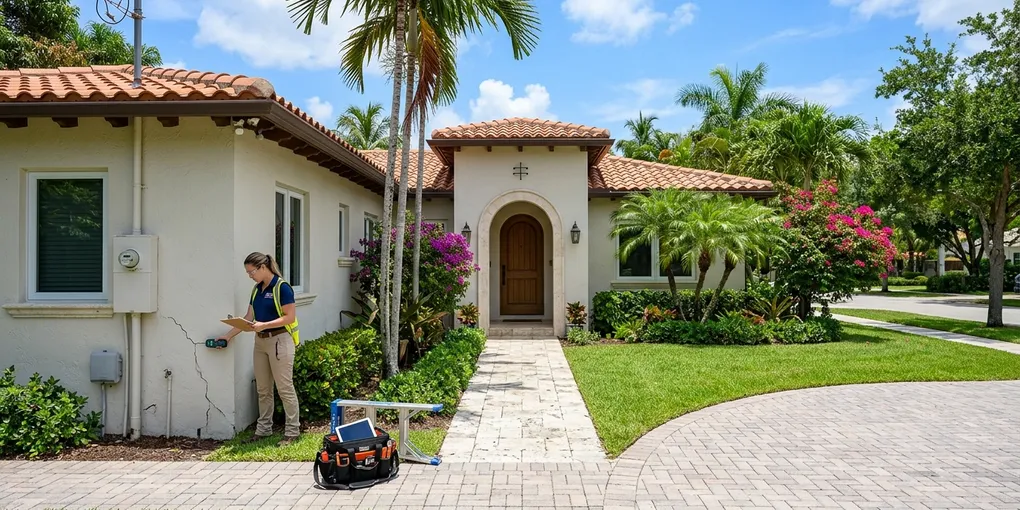
The Ultimate Guide to Spotting Roof Damage in Miami Real Estate Disclosures
Miami represents the pinnacle of tropical luxury, global culture, and architectural glamour. From the historic Mediterranean Revival villas and lush tree-lined canopies of Coconut Grove and Coral Gables to the iconic mid-century modern residences of Morningside and the Upper Eastside, and the Spanish-style family estates of Shenandoah and Pinecrest, Miami’s residential landscape is as stunning as it is unique.
However, behind the swaying royal palms and sun-drenched stucco facades lies a high-stakes structural vulnerability: the tropical marine environment and hurricane corridor of South Florida subject residential roofs to the most extreme physical stresses in the United States.
Operating within the stringent High-Velocity Hurricane Zone (HVHZ) under the Florida Building Code, Miami properties endure Category 4 and 5 hurricane wind uplift forces, torrential tropical rainstorms, salt air aerosol corrosion, and unrelenting subtropical ultraviolet radiation. Because South Florida architecture heavily favors barrel clay/concrete tile roofs or low-slope flat roofs, catastrophic moisture penetration and structural deck rot frequently remain hidden beneath an outwardly intact surface.
Local real estate attorneys and buyer’s brokers regularly see how buyers navigate buyers facing devastating financial consequences because they misunderstood Florida disclosure laws or failed to spot red flags on property disclosures. In this comprehensive guide, we dissect the mechanics of tropical roof deterioration in Miami-Dade County, examine Florida’s landmark Johnson v. Davis disclosure doctrine, analyze the Florida Realtors SPDR disclosure form, and show you how to protect your investment during the due diligence period.
The Engineering of Tropical Roof Degradation in Miami-Dade County
To properly evaluate a Miami home, you must understand how tropical climate extremes interact with regional roofing materials within the High-Velocity Hurricane Zone (HVHZ).
High-Velocity Hurricane Uplift and Wind-Driven Rain
Miami-Dade County enforces the strictest building codes in the nation following Hurricane Andrew:
- Aerodynamic Uplift Forces: Hurricane wind speeds exceeding 140 to 175 mph generate tremendous aerodynamic negative pressure (uplift) across roof eaves, hips, and ridges. These forces tear tiles away from their mortar or foam adhesive bonds and fracture underlying waterproofing membranes.
- Horizontal Wind-Driven Rain: During severe tropical storms, rainwater is forced horizontally at extreme velocities. Water bypasses standard gravity drainage, driving upwards under barrel tile laps, penetrating behind flashing, and forcing its way through soffit vents.
- Salt-Aerosol Fastener Corrosion: Proximity to Biscayne Bay and the Atlantic Ocean creates a continuous salt spray aerosol. Uncoated or poorly galvanized roofing nails and metal valley pans corrode rapidly, weakening the mechanical attachment of roof coverings to the underlying deck.
Spanish Barrel Tile and Underlayment Thermal Desiccation
Mediterranean Revival homes throughout Coral Gables and Coconut Grove feature classic red clay barrel or concrete S-tiles:
- The “Tile Mirage”: While ceramic clay tiles can endure for 50 to 100 years, the waterproof underlayment beneath them has an effective lifespan of only 15 to 20 years in Miami’s intense subtropical climate.
- Thermal Desiccation: Summer rooftop temperatures regularly exceed 160°F to 180°F beneath dark barrel tiles. This continuous heat cooks traditional asphalt-saturated organic felt, evaporating its oils and turning the waterproofing membrane into brittle, crumbling ash.
- Mortar and Foam Decay: In older installations, tiles were set in mortar beds that crack and loosen with age. Even modern two-part expanding foam adhesive pads degrade over time under extreme heat and moisture, allowing tiles to slip out of alignment during high-wind events.
Low-Slope and Flat Roof Ponding on Mid-Century Homes
Throughout Miami’s MiMo historic districts and modern architectural homes, flat and low-pitch roofs are extremely prevalent:
- Ponding Water and Hydrostatic Pressure: In Miami, flat roofs (modified bitumen, built-up tar-and-gravel, or single-ply TPO) frequently suffer from chronic ponding water caused by structural settling or inadequate slope to scuppers and internal drains.
- UV Oxidation and Seam Separation: Intense ultraviolet radiation breaks down asphalt binders in modified bitumen membranes, creating a “chalky” alligator pattern. Standing water combined with UV baking degrades adhesive seams, allowing water to saturate underlying insulation boards and rot tongue-and-groove decking.
Tired of manually reading 200-page disclosures?
Let DisclosurePro AI scan your documents for hidden termite damage, structural issues, and unpermitted work in 10 seconds. Try it free today.
Florida Real Estate Disclosure Laws: Johnson v. Davis and the SPDR-3 Explained
Florida possesses one of the most famous and influential consumer-protection disclosure doctrines in American jurisprudence, but buyers must understand how it applies to roof defects.
The Landmark Precedent: Johnson v. Davis (1985)
In the historic case of Johnson v. Davis, 480 So. 2d 625 (Fla. 1985), the Florida Supreme Court abolished the strict doctrine of caveat emptor in residential real estate transactions:
- The Affirmative Disclosure Rule: The court held that where the seller of a home knows of facts materially affecting the value of the property which are not readily observable and are not known to the buyer, the seller is under an affirmative legal duty to disclose them to the buyer.
- The Facts of the Case: The lawsuit directly involved a seller who failed to disclose a leaking roof, claiming the water marks on the ceiling were from prior window leaks. The court ruled that the seller had committed fraudulent concealment.
The Florida Realtors® Seller’s Property Disclosure (SPDR-3)
In standard residential sales throughout Miami-Dade County, sellers complete the Florida Realtors SPDR-3 form:
- Section 2 – Roof and Gutters: The seller must disclose the approximate age of the roof, the date the roof was last replaced or repaired, whether there are any past or present leaks, and whether any past repairs were made.
- HVHZ and Insurance: The seller must state whether the roof complies with the Florida Building Code, whether any insurance claims for wind or hurricane damage have been filed, and whether any manufacturer or contractor warranties exist.
- Permits and Code Compliance: Inquires whether all roof work was performed with required Miami-Dade County building permits and received final inspection sign-offs.
The “Actual Knowledge” Boundary and “As-Is” Transactions
Many sellers in Miami use the Florida Realtors/Florida Bar “AS IS” Residential Contract for Sale and Purchase:
- Under Florida law, signing an “AS IS” contract does not relieve the seller of their duty under Johnson v. Davis to disclose known latent material defects.
- However, sellers are only bound to disclose defects of which they have actual knowledge. If an out-of-state investor or trust administrator acquired a property in Little Havana or North Miami through an estate, they often provide an exempt disclosure or mark “Don’t Know” across every category.
- Furthermore, sellers who hired an unlicensed handyman to spread silicone sealant over cracked tiles will frequently check “No known leaks,” rationalizing that their temporary fix resolved the problem permanently.
Evasive Phrasing in Miami Seller Disclosures
When reviewing Florida disclosure documents, watch out for these common evasive statements:
- “Barrel tile roof inspected after Hurricane Ian; no missing tiles observed” — Ignores the fact that high winds broke mortar or adhesive bonds and cracked underlying desiccated underlayment without dislodging the heavy tiles.
- “Flat roof resealed with silicone coating in 2023” — Often a cheap cosmetic measure used to avoid an expensive full tear-off and replacement.
- “Roof age estimated by previous owner; working well” — A classic phrase used to dodge legal liability for a roof that is at the end of its insurable life.
- “No active leaks during current ownership” — In South Florida, where insurance companies require proof of roof age under 15 years for underwriting, a roof may be “leak-free” but completely uninsurable.
The Manual Review Problem: Navigating the Florida Insurance and Inspection Window
Under the standard Florida “AS IS” contract, buyers typically negotiate an Inspection Period of 10 to 15 calendar days (often compressed to 7 days in competitive markets).
During this narrow window, the buyer must coordinate:
- The comprehensive Florida Realtors SPDR disclosure statement.
- The 50-to-80-page general home inspection report.
- The mandatory Four-Point Inspection (Roof, Electrical, Plumbing, HVAC) and Wind Mitigation Inspection required by Florida homeowner insurance carriers.
- Miami-Dade County Regulatory and Economic Resources (RER) permit portal records to verify that previous reroofs had permits pulled, Notice of Commencement recorded, and final inspections passed.
- Invoices and transferable manufacturer warranty certificates.
General home inspectors in South Florida will not walk on fragile barrel clay tiles or wet flat roofs, stating in their reports: “Due to fragile nature of barrel tiles and steep pitch, roof inspected from ladder at eaves and drone photography.” A drone cannot check if mortar bonds have failed, lift tiles to inspect underlying felt, or determine if tongue-and-groove wood decking is saturated with moisture. Furthermore, if a roof is older than 15 years, Florida insurance carriers may refuse to issue coverage regardless of what the general inspector reports.
Financial Impact: A Real-World Coral Gables Mediterranean Case Study
To understand how an overlooked roof disclosure can result in catastrophic financial losses, consider this realistic scenario from Miami’s historic Coral Gables neighborhood.
The Purchase
Carlos and Sofia purchased a 1948 Mediterranean Revival home in Coral Gables for $1,350,000. The property featured historic banyan trees, an enclosed courtyard patio, and a picturesque Spanish barrel clay tile roof.
On the Florida Realtors SPDR disclosure statement, the seller checked “No” to roof defects and added a handwritten note: “Tile roof tuned up in 2023; new mortar applied on ridge caps. No active leaks.” The general home inspector used a drone to photograph the roof, noting: “Clay tiles appear uniform and in satisfactory condition with minimal cracked tiles visible.” The four-point inspection noted the roof was in “functional condition.” Carlos and Sofia removed their inspection contingency and closed on the purchase.
The Tropical Storm and Insurance Cancellation
Eight months later, a strong tropical storm swept through South Florida, bringing 60 mph sustained winds and 6 inches of torrential driving rain across Miami-Dade County.
Within hours, water began pouring through the tongue-and-groove cypress beam ceiling in the formal living room and dripping down the plaster walls of the master suite. When a licensed Florida CCC roofing contractor climbed onto the roof, the devastating truth was uncovered:
- The roof was actually 28 years old; the original 30-lb organic felt underlayment was completely burned out from decades of subtropical heat and had disintegrated into brittle flakes.
- The seller’s “2023 tune-up” consisted of an unlicensed laborer applying mortar over broken ridge caps and painting over cracked tiles with silicone without addressing the desiccated underlayment beneath.
- High tropical winds drove rain straight up beneath the barrel tile laps, where it flowed directly through the rotted felt and saturated the roof decking.
- Water intrusion had rotted out 450 square feet of original 1-inch tongue-and-groove cypress roof sheathing and degraded four structural framing rafters, while active black mold spread across the attic space.
- To make matters worse, Carlos and Sofia’s insurance carrier sent an adjuster who determined the roof had pre-existing severe wear, denying the water damage claim and issuing an immediate 30-day notice of policy cancellation.
The Financial Devastation
Because the seller technically disclosed a “tune-up” and claimed they had no actual knowledge of rotted decking beneath the tiles, proving intentional fraud under Johnson v. Davis proved legally difficult and expensive. Carlos and Sofia had to absorb the entire reconstruction expense out-of-pocket:
| Expense Item | Cost |
|---|---|
| Complete tile lift, salvage, cleaning, and palletizing on-site | $9,800 |
| Removal and hazardous disposal of deteriorated felt and rotted cypress sheathing | $3,200 |
| Replacement of damaged tongue-and-groove roof decking with exterior-grade plywood | $6,400 |
| Sistering and structural reinforcement of compromised cypress roof rafters | $8,500 |
| Installation of HVHZ-compliant self-adhering high-temp modified bitumen underlayment (dual-ply) | $8,900 |
| Re-installation of salvaged barrel tiles using approved two-component expanding foam adhesive | $16,800 |
| Custom copper valley pans, eave drip edge, and lead flashing fabrication | $5,200 |
| Interior historic plaster ceiling restoration, mold remediation, and wood refinishing | $7,800 |
| Miami-Dade County Building Department HVHZ reroof permit and engineering fees | $1,200 |
| Total Devastation | $67,800 |
Frequently Asked Questions about Roof Issues in Miami
1. What is the High-Velocity Hurricane Zone (HVHZ) and why does it matter in Miami?
The High-Velocity Hurricane Zone (HVHZ) is a specific designation within the Florida Building Code that covers Miami-Dade and Broward counties. It enforces the most stringent roofing standards in the world, requiring roof coverings, underlayments, fasteners, and adhesives to be tested and approved (via a Miami-Dade Notice of Acceptance - NOA) to withstand winds exceeding 140 to 175 mph.
2. What is Florida’s “25% Roof Replacement Rule”?
Historically under the Florida Building Code, if more than 25% of a roof section was repaired or replaced within a 12-month period, the entire roof had to be brought into compliance with the current building code, often forcing a full replacement. Following legislative updates in 2022 (SB 4-D), roofs built or replaced under the 2007 Florida Building Code or later may now be repaired beyond 25% without triggering a mandatory full replacement, provided the existing roof remains structurally sound.
3. How does roof age affect homeowner insurance in Miami?
Roof age is the single most critical factor in securing homeowner insurance in Miami. Many Florida insurance carriers refuse to write new policies on homes with asphalt shingle roofs older than 10 to 15 years or tile roofs older than 15 to 20 years, regardless of whether the roof leaks. Homes with older roofs face exorbitant premiums from state-backed Citizens Property Insurance or mandatory reroof requirements within 30 days of closing.
4. What is a Wind Mitigation Inspection in Florida?
A Wind Mitigation Inspection is a specialized evaluation performed by a certified inspector that documents a home’s hurricane-resistant features, including roof shape (hip roofs perform best), roof deck attachment (nail size and spacing), roof-to-wall connections (hurricane clips or straps), secondary water resistance (sealed roof deck), and opening protection (impact windows or shutters). A favorable wind mitigation report can save Miami homeowners thousands of dollars annually on their insurance premiums.