
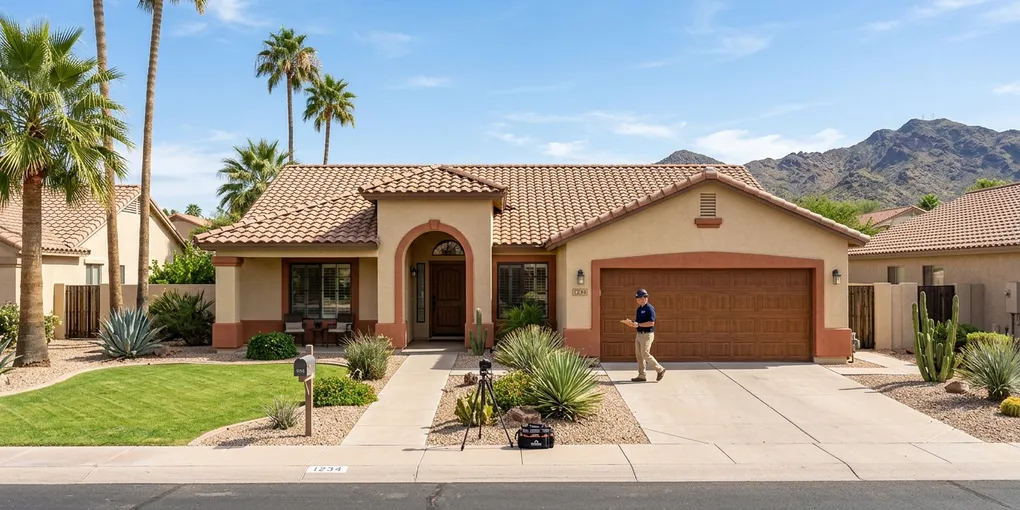
The Ultimate Guide to Spotting Roof Damage in Mesa Real Estate Disclosures
Nestled beneath the majestic backdrop of the Superstition Mountains and the Usery Pass, Mesa is the vibrant anchor of Phoenix’s East Valley. From master-planned golf communities like Las Sendas and Red Mountain Ranch to the established family neighborhoods of Dobson Ranch and Alta Mesa, homebuyers are drawn to Mesa’s booming economy, exceptional recreation, and picturesque desert lifestyle.
Yet, behind the pristine stucco walls and desert landscaping lies a constant, unforgiving reality: the extreme climate of the Sonoran Desert is catastrophic to residential roofs.
With over 300 days of blistering sunshine, summer temperatures routinely surpassing 115°F, intense ultraviolet radiation, and violent summer monsoon dust storms and microbursts, Mesa roofs operate under extreme thermal stress. Because the vast majority of East Valley homes are constructed with concrete or clay tiles, catastrophic waterproofing failure remains hidden beneath an outwardly intact exterior until water pours through the ceiling during a summer monsoon.
As an experienced Arizona real estate attorney and East Valley broker, I routinely watch buyers inherit tens of thousands of dollars in emergency roof repairs because they didn’t know how to scrutinize the seller’s disclosure statement. In this comprehensive guide, we dissect the biology and physics of desert roof failure, explain Arizona disclosure statutes and the AAR SPDS form, and show you exactly how to protect your investment during the inspection period.
The Engineering of Desert Roof Degradation in Mesa
To protect yourself when evaluating a Mesa home, you must understand how desert environmental factors interact with regional roofing materials.
Sonoran Solar Baking and Underlayment Thermal Desiccation
Most homes built in Mesa between the 1970s and 2010s feature concrete or clay “S-tile” or flat tile roofing. While tiles themselves are practically permanent, the waterproofing system beneath them is not:
- Attic and Roof Deck Heat: In July and August, when ambient temperatures reach 115°F, dark concrete tiles can heat up to an astonishing 160°F to 180°F. This radiant heat cooks the attic space and the roof deck sheathing.
- The “Baking” of Organic Felt: Traditional asphalt-saturated felt (No. 30 or No. 40 organic paper) is petroleum-based. Under chronic extreme heat, the volatile oils and plasticizers within the asphalt evaporate. Over 15 to 20 years, the felt underlayment bakes into a brittle, cracked, paper-thin layer resembling burnt parchment.
- Hidden Structural Deterioration: From the street or driveway, the concrete tiles look as sturdy as the day they were installed. But the moment rainwater or wind-driven dust slips between tile interlocks, the disintegrated felt offers zero resistance, funneling water directly onto the wood framing below.
Monsoon Microbursts and Haboob Dust Accumulation
Every summer between June and September, the North American Monsoon brings violent weather patterns to the East Valley:
- Microburst Wind Shear: Monsoon storms frequently produce sudden straight-line winds and microbursts with gusts of 60 to 80 mph. These winds generate powerful aerodynamic uplift pressures that lift or dislodge heavy concrete tiles, tearing through brittle underlayment.
- Water Damming from Haboob Dust: Massive desert dust storms (“haboobs”) sweep across Maricopa County, depositing inches of fine silt beneath tile channels and in roof valleys. When cloudbursts strike, this silt turns into dense mud, clogging water channels and forcing rainwater sideways under tile laps.
- Canale and Scupper Overflows: On flat-roof Territorial or Southwestern-style homes in Mesa, parapet canales and scuppers quickly become choked with blowing desert debris, turning flat roofs into temporary reservoirs that exert intense hydrostatic pressure on aging foam or modified bitumen seams.
Foam Roof UV Chalking and Hail Pitting
Sprayed Polyurethane Foam (SPF) is popular on low-slope homes and additions throughout Mesa:
- Protective Coating Decay: Foam roofs rely entirely on an elastomeric coating (acrylic or silicone) to shield the foam from UV radiation. In Mesa’s intense sun, uncoated foam will oxidize and powder (“chalk”) within months.
- Bird Pecking and Hail Bruising: Desert birds love pecking into unprotected foam to look for insects, and desert hail storms create deep pockmarks. If the elastomeric topcoat is not recoated every 5 to 7 years, water ponds in these divots, saturating the foam core down to the deck.
Tired of manually reading 200-page disclosures?
Let DisclosurePro AI scan your documents for hidden termite damage, structural issues, and unpermitted work in 10 seconds. Try it free today.
Arizona Real Estate Disclosure Laws: The AAR SPDS Unpacked
Arizona is governed by robust case law and standardized association contracts designed to ensure transparency, but buyers must know how to spot ambiguous responses.
The Residential Seller’s Property Disclosure Statement (SPDS)
Created by the Arizona Association of REALTORS® (AAR), the SPDS (pronounced “speed-us”) is the cornerstone of every residential transaction in Arizona:
- Section 3 – Building and Safety (Roof): The seller is required to disclose the approximate age of the roof, the type of roof covering, whether the roof has leaked during their ownership, and the date and description of any past repairs.
- Warranties and Recoats: The seller must state whether there is an existing transferable roof warranty and, for flat/foam roofs, the date the roof was last recoated.
- Water Damage and Claims: Inquires whether the property has sustained past water intrusion or if any homeowner insurance claims for wind or hail have been processed.
The Legal Framework: Actual Knowledge vs. Latent Defects
Under the Arizona Supreme Court ruling in Hill v. Jones (1986), a seller has an affirmative legal duty to disclose known facts that materially affect the value or desirability of a property if those facts are not known or readily observable by the buyer:
- However, the seller is only obligated to disclose defects of which they have actual knowledge.
- A homeowner who has lived in an air-conditioned Dobson Ranch home for fifteen years without an active interior leak may genuinely have no idea that their underlayment has completely disintegrated into ash. They can legally check “No” to roof defects and “Unknown” to roof age without committing fraud.
- Similarly, institutional investors and iBuyers who flip properties in East Mesa often complete an “exempt” disclosure or check “Do Not Know” across all categories, passing complete risk onto the buyer.
Evasive Phrasing in Mesa SPDS Documents
When reviewing Section 3 of an Arizona SPDS, look out for these misleading phrases:
- “Tile roof is original and built to last a lifetime” — A classic half-truth. The concrete tiles may last 50+ years, but the underlayment underneath died twenty years ago.
- “Minor leak around valley repaired by local handyman in 2023” — An admission that underlayment failure has already begun. In Mesa, patching one leak on an aged tile roof is like putting a Band-Aid on a burst pipe; adjacent underlayment is equally brittle and ready to fail.
- “Foam roof resealed prior to listing” — Often means the seller rolled on a single thin coat of cheap acrylic paint to hide peeling foam without addressing underlying moisture saturation.
- “No leaks during my ownership” — In desert areas that receive only 8 to 9 inches of rain a year, a roof can be completely compromised for years without showing an interior leak—until an extraordinary monsoon storm arrives.
The Manual Review Problem: Surviving the Arizona Due Diligence Period
Under the standard Arizona Residential Resale Real Estate Purchase Contract, the default Inspection Period is 10 calendar days.
During these 10 days, the buyer must review and evaluate:
- The 7-page Arizona SPDS document and all accompanying explanations.
- The 50-to-80-page general home inspection report.
- City of Mesa Development Services building permit records to verify if past roof replacements had permits pulled and final inspections signed off.
- Comprehensive Loss Underwriting Exchange (C.L.U.E.) reports detailing past insurance claims on the property.
- Licensed ROC (Registrar of Contractors) inspection reports and warranty transfer conditions.
General home inspectors in Arizona are not roofing contractors. Most home inspectors carry strict disclaimers in their contracts stating: “Tile roofs inspected from perimeter ladder only due to risk of cracking fragile tiles.” A visual assessment from the edge of the gutter cannot tell you whether the underlayment beneath the tiles is dried out or split. If a buyer fails to dig into the seller’s SPDS and demand a dedicated ROC-licensed roof inspection, they can inherit staggering liabilities.
Financial Impact: A Real-World Las Sendas Tile Roof Case Study
To understand how an overlooked disclosure note can result in severe financial damage, examine this realistic scenario from Mesa’s upscale Las Sendas community.
The Purchase
Jason and Megan purchased a lovely 1999 Southwestern-style home in Las Sendas for $620,000. The home offered stunning mountain views, a resort-style pool, and a classic Mediterranean-style concrete S-tile roof.
On the AAR SPDS form, the seller marked the roof age as “Original (~25 years),” checked “No” to active leaks, and added an explanatory note: “Tile roof tuned up in 2022; cracked tiles replaced.” The general home inspector’s report noted: “Tiles appear in satisfactory condition; no active moisture detected in attic with moisture meter.” Jason and Megan waived further roof inspections and closed on the home.
The July Monsoon
Ten months later, during a mid-July monsoon storm, a severe microburst swept through northeast Mesa, dumping 2.8 inches of rain with 65 mph gusts in under an hour.
Within twenty minutes, water began streaming through recessed can lights in the kitchen and pooling on the hardwood floors in the family room. When a licensed Arizona C-42 roofing contractor lifted several sections of concrete tile the following morning, the full disaster was exposed:
- The original 30-lb organic felt underlayment had completely disintegrated from 25 years of desert heat, leaving bare plywood decking exposed between rafter bays.
- The seller’s “2022 tune-up” consisted of a roofer simply caulking a few visible cracked tiles with polyurethane sealant without addressing the desiccated underlayment beneath.
- High monsoon winds drove rain straight up beneath the tile laps, where it flowed unimpeded through the rotted felt and saturated the roof decking.
- Water intrusion caused catastrophic rot in 400 square feet of OSB decking, rotted rafter tails in the eaves, and ruined the custom kitchen cabinetry and insulation below.
The Financial Devastation
Because the seller accurately stated the roof was 25 years old and disclosed the tune-up, there was no legal basis for a fraud claim. Jason and Megan had to pay for the complete reconstruction out-of-pocket:
| Expense Item | Cost |
|---|---|
| Complete tile lift, salvage, cleaning, and stacking on-site | $7,500 |
| Removal and hazardous disposal of deteriorated felt and rotted OSB sheathing | $2,600 |
| Replacement of damaged roof decking with 1/2“ CDX plywood | $4,800 |
| Replacement of rotted eave rafter tails and structural wood fascias | $3,900 |
| Installation of premium high-temperature dual-ply modified bitumen underlayment (30-year system) | $8,200 |
| Re-installation of salvaged concrete tiles with new mechanical fasteners and eave metal | $6,800 |
| Custom valley fabrication, lead pipe jacks, and counter-flashing | $2,400 |
| Kitchen ceiling drywall replacement, custom cabinet repair, and mold remediation | $6,200 |
| City of Mesa residential reroof building permit and inspection fees | $550 |
| Total Out-of-Pocket Expense | $42,950 |
Frequently Asked Questions about Roof Issues in Mesa
1. How long does a tile roof underlayment last in Mesa, Arizona?
In the extreme heat of Mesa and the Phoenix East Valley:
- Standard Organic Felt (No. 30/No. 40): Lasts roughly 15 to 20 years. In homes built in the 1990s or early 2000s, original organic felt is almost certainly at the end of its useful life.
- Modern Synthetic / Modified Bitumen Underlayment: Specifically engineered for high temperatures, modern SBS-modified rubberized asphalt underlayment can last 30 years or more.
2. What is a “tile lift and reset” and when is it required?
A “tile lift and reset” (or “R&R” - remove and replace) is the standard method for restoring a concrete or clay tile roof. Because tiles rarely degrade, roofers carefully remove and stack the existing tiles, strip away the failing felt underlayment, repair any rotted wood decking or fascia, install new high-temp underlayment, and reinstall the original tiles. It is required when underlayment reaches 20+ years of age or begins leaking in multiple locations.
3. What does “tile chatter” mean during a Mesa monsoon storm?
“Tile chatter” refers to the sound made when high monsoon winds lift unfastened or loosely secured concrete tiles and cause them to rattle against the roof deck. Prolonged tile chatter breaks the underlying underlayment and can cause tiles to crack or slide off the roof entirely.
4. How often must a foam roof be recoated in Mesa?
In Mesa’s high-UV climate, a sprayed polyurethane foam (SPF) roof must be professionally inspected, cleaned, and recoated with an elastomeric coating (acrylic or silicone) every 5 to 7 years. Allowing the protective coating to wear away exposes the raw foam to sunlight, causing rapid powdering, bird damage, and leaks.