
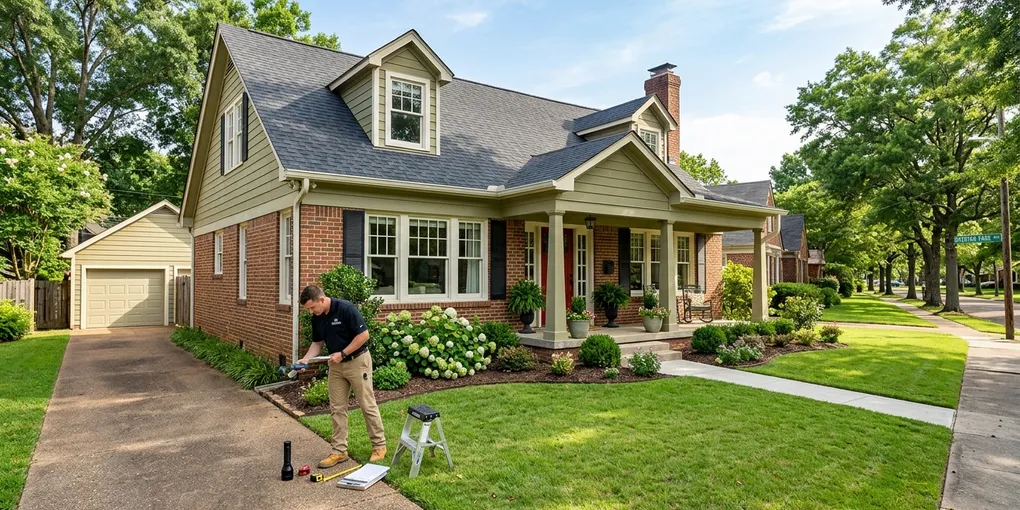
The Ultimate Guide to Spotting Roof Damage in Memphis Real Estate Disclosures
Memphis stands as a legendary cultural cornerstone of the American South. Perched above the mighty Mississippi River on the Chickasaw Bluffs, the “Bluff City” is internationally renowned for its deep musical heritage, world-class culinary traditions, and remarkably rich residential architecture. From the stately Southern estates and historic brick Tudors of Central Gardens and Chickasaw Gardens to the artistic Craftsman bungalows of Midtown and Cooper-Young, through to the expansive mid-century ranches of East Memphis, the city offers homebuyers extraordinary architectural diversity and compelling real estate value.
However, towering above Memphis’s picturesque neighborhoods is a natural feature that poses an unrelenting structural hazard to residential properties: a dense, mature canopy of historic hardwood trees.
Situated in the heart of the Mid-South, Memphis experiences a humid subtropical climate defined by sweltering summer heatwaves, intense convective thunderstorms with destructive straight-line winds, severe tornado-season hail, and devastating winter ice storms. When heavy freezing rain coats Memphis’s massive water oaks, post oaks, and pecan trees, limbs snap and crash onto residential roofs. Combined with blistering summer humidity that accelerates shingle decay, uninspected roofs often harbor severe hidden damage. Overlooking ambiguous language or deliberate omissions in a Tennessee residential disclosure can leave an unsuspecting buyer facing catastrophic out-of-pocket structural repair costs.
As a practicing Tennessee real estate attorney and active Memphis broker, I routinely guide buyers through complex property transactions where an overlooked roofing red flag turns a dream home into a severe financial burden. In this comprehensive guide, we dissect the mechanics of Mid-South roof failures, analyze Tennessee’s statutory disclosure laws, and expose the subtle red flags sellers use to mask damaged roofs.
The Anatomy of Memphis Roof Damage: Ice Storms, Oak Canopies, and Summer Heat
Evaluating a property in Shelby County requires an understanding of how the Mid-South’s distinctive climate attacks residential roofing assemblies.
The Mid-South Winter Ice Storm Menace
While Memphis receives modest amounts of snow, it sits squarely in the path of severe winter freezing rain events:
- Catastrophic Limb Strikes: In notorious Mid-South ice storms, freezing rain coats trees in sheets of ice up to an inch thick. Massive oak and pecan limbs—weighing hundreds of pounds—snap under the immense load and crash onto roofs. Even if a limb does not punch completely through the ceiling, the kinetic impact frequently cracks structural rafters, fractures wood decking boards, and shatters shingle mats.
- Freeze-Thaw Water Seepage: As ice melts across roof planes, water backs up behind ice-clogged gutters and seeps upward beneath shingle laps, saturating fascia boards and rotting soffits.
Severe Straight-Line Winds and Tornado Season Gusts
Spring in the Mid-South brings intense convective storm fronts and derecho wind events:
- Wind-Uplift and Tab Tearing: Thunderstorm wind gusts exceeding 65 to 70 miles per hour generate powerful aerodynamic uplift along roof eaves, ridges, and gables. This uplift breaks the factory thermal sealant bonds on asphalt shingles, causing them to flap violently. Once unsealed, shingles develop micro-tears along nail lines and blow off during subsequent storms.
- Hail Bruising: Convective supercells drop hail that pulverizes protective mineral granules, leaving the underlying asphalt exposed to rapid solar breakdown.
Extreme Summer Heat and Attic Baking
During Memphis summers, temperatures frequently soar into the high 90s with stifling humidity, driving attic temperatures well above 145°F:
- Bitumen Desiccation: Continuous heat without adequate attic ventilation bakes the volatile petroleum oils out of asphalt shingles. Shingles become brittle, lose their flexibility, and curl at the corners.
- Gloeocapsa Magma Colonization: The persistent humidity fuels the rapid growth of Gloeocapsa magma, the blue-green algae responsible for black streaks on roofs across Midtown and East Memphis. The algae feeds on the limestone filler in fiberglass shingles, gradually eroding the shingle structure and diminishing solar reflectivity.
Tired of manually reading 200-page disclosures?
Let DisclosurePro AI scan your documents for hidden termite damage, structural issues, and unpermitted work in 10 seconds. Try it free today.
Navigating Tennessee Real Estate Disclosure Laws in Memphis
In Tennessee, residential property sales are governed by the Tennessee Residential Property Condition Disclosure Act, providing buyers with statutory safeguards against undisclosed latent defects.
Tennessee Code Annotated § 66-5-201 et seq. and the Disclosure Form
Under T.C.A. § 66-5-202, a residential seller must deliver a completed Tennessee Residential Property Condition Disclosure form (standardized by Tennessee REALTORS® Form RF 201) prior to contract execution.
Section B of the Tennessee disclosure form specifically interrogates the seller regarding the roof:
- Item 1: “Roof: Approximate Age of Roof Covering”
- Item 2: “Are you aware of any roof defects, active leaks, or previous water penetration?”
- Item 3: “Have any roof repairs or replacements been made during your ownership?”
- Structural Integrity: Inquires about known rafter cracking, settling, or moisture intrusion into attics and living spaces.
The “Disclosure” vs. “Disclaimer” Alternative
Tennessee law provides sellers with an important alternative under T.C.A. § 66-5-202(2):
- A seller may elect to execute a Residential Property Condition Disclaimer Statement.
- By signing a Disclaimer Statement, the seller states that the property is being sold without any representations or warranties as to its condition, and the buyer agrees to purchase the property in “as-is” condition.
- While common in investor-owned or foreclosure properties across Memphis, when a traditional seller insists on a Disclaimer rather than a full Disclosure, it serves as an immediate red flag that the seller may be concealing serious deferred maintenance or roof failures.
Seller Duties and Remedies for Fraudulent Concealment
If a seller delivers a Disclosure Statement, Tennessee law mandates that all representations be made in good faith based on the seller’s actual knowledge.
Under T.C.A. § 66-5-208, if a seller knowingly makes a false statement or conceals a known defect on the disclosure form, the buyer has statutory remedies:
- The buyer may sue to recover actual damages and repair costs.
- In severe cases involving intentional fraud or willful concealment, courts can order contract rescission and award reasonable attorney fees.
Evasive Phrasing Used by Memphis Sellers
Despite these statutory rules, sellers in competitive Memphis submarkets frequently employ evasive language to deflect scrutiny:
- “Roof inspected after 2023 storm; certified in good working order” (masking that the roofer only replaced several ridge caps while noting severe underlying hail bruising).
- “Roof age estimated at 7 years” (failing to disclose that the roof was an unpermitted second layer nailed over rotted pine decking).
- “Minor ceiling water mark from previous storm; repaired and painted” (cosmetically primed with stain-blocking paint without addressing rotted chimney step flashing).
- “Seller is an investor / corporate trustee and has never occupied property” (used to mark ‘Unknown’ across all structural sections).
The Manual Review Problem: Drowning in Memphis Due Diligence
Under the standard Memphis Area Association of REALTORS® (MAAR) Purchase and Sale Agreement, buyers typically negotiate an inspection contingency period of 10 to 14 days.
During this tight timeframe, prospective buyers must digest an overwhelming collection of complex documents:
- The 5-page Tennessee Residential Property Condition Disclosure statement.
- The Memphis and Shelby County Division of Planning and Development permit records.
- Historic Landmarks Commission (HLC) guidelines (for homes in Central Gardens or Victorian Village).
- The private home inspection report (often 50 to 80 pages).
- Specialized wood-destroying insect (WDI) termite inspection reports and sewer lateral scopes.
The most catastrophic roof issues are often buried in dense technical observations. For example, a home inspector might write a brief note on page 44: “Observed moderate granule loss and localized tree branch rubbing on north roof slope; recommend trimming overhanging limbs.” A casual buyer might assume this is minor landscaping maintenance. In reality, in Memphis’s humid climate, tree branch abrasion strips protective granules down to bare fiberglass, allowing driving thunderstorm rain to penetrate decking and saturate attic insulation.
Financial Impact: A Real-World Central Gardens Case Study
To see how disastrous an unvetted roof disclosure can be in Memphis, consider this realistic scenario from a historic home purchase in Central Gardens.
The Purchase
Darius and Monica purchased a graceful 1925 Craftsman home in Central Gardens for $540,000. On the Tennessee Property Condition Disclosure form, the seller answered “No” to active roof leaks and wrote under Item 1: “Roof replaced in 2018 with 30-year architectural shingles; tree maintenance completed annually.”
Their general home inspector performed a standard inspection. Due to damp morning weather and steep pitches, the inspector evaluated the roof from ground level using binoculars and a pole camera, noting: “Architectural shingles appear uniform and in satisfactory condition; no active interior ceiling staining observed.” Reassured by the seller’s statement that the roof was only eight years old, Darius and Monica finalized the purchase.
The Disaster
The following February, Memphis was struck by a severe Mid-South winter ice storm. Freezing rain accumulated for twelve hours, coating mature water oaks across Central Gardens with over 3/4-inch of ice.
Under the immense weight of the ice, a massive 12-inch oak limb broke free sixty feet above the house and slammed into the rear roof slope. When Darius hired an experienced local roofing and structural contractor to assess the impact, the contractor uncovered a structural disaster that went far beyond the broken limb:
- The 2018 roof installation was an unpermitted, illegal overlay. The contractor had nailed modern architectural shingles directly over two historic layers of brittle shingles and decaying wood decking.
- The weight of the three roofing layers, combined with historical ice storm impacts, had severely cracked four original 2x6 heart-pine roof rafters.
- The seller had experienced a previous limb strike during a 2022 storm, paid an unlicensed handyman $500 to patch the shingles cosmetically, and actively concealed the fractured rafters beneath blown-in insulation.
- Heavy meltwater from the ice storm had seeped through the unsealed patch, completely saturating the ceiling joists, ruining blown-in insulation, and sparking extensive toxic mold growth across the upstairs attic.
The Financial Devastation
Because the seller had dissolved their estate trust and relocated out of state, recovering damages in court was legally uncertain and cost-prohibitive. Darius and Monica had to pay out-of-pocket for complete structural restoration:
| Expense Item | Cost |
|---|---|
| Emergency crane service, tree limb removal, and roof tarping | $4,500 |
| Hazardous tear-off and disposal of three illegal roofing layers | $13,200 |
| Structural rafter replacement, timber sistering, and ridge beam shoring | $17,400 |
| Installation of 5/8-inch CDX plywood sheathing and high-temp ice barrier | $9,800 |
| Installation of premium 50-year algae-resistant architectural shingles | $17,500 |
| Chimney flashing rebuild, counter-flashing, and masonry tuckpointing | $4,200 |
| Upstairs historic lathe-and-plaster ceiling restoration, insulation, and repainting | $11,600 |
| City of Memphis and Shelby County building permits and structural inspection | $1,600 |
| Total Devastation | $79,800 |
Frequently Asked Questions about Roof Issues in Memphis
1. Does tree canopy coverage void roof warranties in Memphis?
While having trees near your home does not automatically void a warranty, shingle manufacturers (including GAF and CertainTeed) explicitly exclude damage caused by tree limb abrasion, fallen branches, unmitigated moss or algae growth, and continuous moisture retention from heavy debris accumulation. Keeping overhanging branches trimmed back at least 10 feet from roof planes is critical to maintaining valid warranty coverage in Memphis.
2. Can you nail a second layer of shingles over an existing roof in Tennessee?
While the International Residential Code (IRC) permits a maximum of two layers of asphalt shingles under specific conditions, roofing experts and structural engineers strongly discourage overlays in Memphis. Adding a second layer traps heat in hot Mid-South summers, adds immense structural dead load, voids manufacturer warranties, and prevents inspectors from discovering hidden rafter fractures caused by past tree limb strikes.
3. What does Tennessee law require sellers to disclose about past storm damage?
Under the Tennessee Residential Property Condition Disclosure Act (T.C.A. § 66-5-201), sellers must disclose all known past defects, active leaks, and insurance claims or repairs resulting from storm, wind, or ice damage. Concealing known limb damage or past water penetration constitutes fraudulent concealment under Tennessee law.
4. What is the typical lifespan of an architectural asphalt shingle roof in Memphis?
In Memphis’s punishing climate—marked by extreme summer UV radiation, high humidity, convective thunderstorms, and winter freezing rain—architectural dimensional shingles typically last 18 to 22 years. Standard 3-tab shingles frequently fail in as few as 12 to 15 years, particularly on roof slopes exposed to heavy tree shade or poor attic ventilation.