
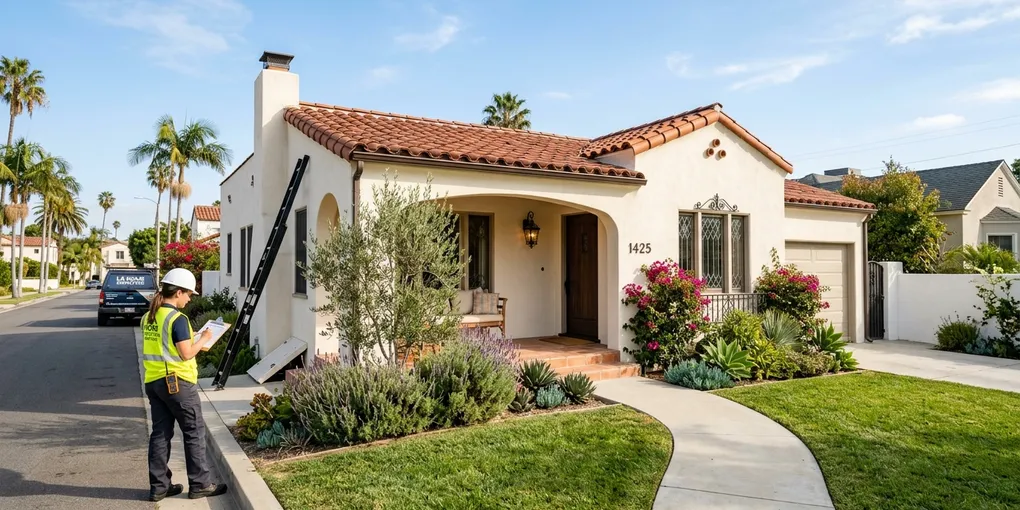
The Ultimate Guide to Spotting Roof Damage in Los Angeles Real Estate Disclosures
From the hillside architectural estates of the Hollywood Hills and Mid-Century Modern gems in Silver Lake to Spanish Colonial Revivals in Pasadena and Craftsman bungalows in Venice, the Los Angeles housing market is one of the most competitive and architecturally diverse in the world. Yet beneath the manicured landscaping, sunset views, and flawless staging, there lies an expensive structural hazard that catches thousands of Southern California homebuyers off guard every single year: hidden roof failure.
Many prospective buyers mistakenly believe that Southern California’s sunny, drought-prone climate makes roof integrity a secondary concern. In reality, the Los Angeles climate creates some of the most aggressive conditions for roof deterioration anywhere in the country. When blistering summer heat and intense ultraviolet radiation are combined with sudden winter “atmospheric river” rainstorms, an aged or poorly maintained roof will fail catastrophically.
Local real estate attorneys and buyer’s brokers regularly see how buyers navigateed numerous buyers who discovered devastating roof leaks within weeks of taking title. In this guide, we will examine the unique structural mechanics of LA roofs, dissect California disclosure statutes, and teach you how to decode evasive seller disclosure statements before you waive your contractual contingencies.
The Hidden Culprits Behind Los Angeles Roof Failures
Understanding how roofs fail in Los Angeles requires looking beyond the exterior surface. While a roof may appear pristine from the street, severe structural decay often hides directly beneath the outer coverings.
The Clay and Concrete Tile Paradox: The Failing Underlayment
A significant portion of Southern California’s residential architectural stock features Spanish barrel tile, mission clay tile, or flat concrete tile roofs. Homeowners frequently boast that clay tile roofs last 50 to 100 years. While the clay or concrete tiles themselves are virtually indestructible, the underlayment felt beneath them has a far shorter lifespan:
- The Baking Effect: In Los Angeles, summertime rooftop temperatures easily exceed 150°F to 160°F. This thermal baking turns standard 30-pound asphalt-saturated roofing felt brittle, causing it to dry out, curl, and turn into dust after 20 to 25 years.
- Water Pathways: When rain falls, curved Spanish tiles are designed to direct water into underlying channels and valleys. If the underlayment is brittle or torn, wind-driven moisture slips beneath the tiles and pours directly into the attic framing and drywall ceilings.
- The “Lift and Reset” Reality: Fixing this issue requires a complete “lift and reset”—carefully removing every existing tile, hauling away rotted underlayment, installing modern synthetic underlayment and flashing, and reinstalling the tiles. This labor-intensive process often costs as much as an entirely new roof.
Flat Roofs, Tar & Gravel, and Mid-Century Modern Homes
Across LA’s sprawling Mid-Century Modern enclaves, low-slope and flat roofs with wide overhangs are architectural staples. These systems rely heavily on:
- Built-Up Tar & Gravel or Torch-Down Bitumen: These membranes are particularly vulnerable to thermal expansion and contraction cycles. Over time, the seams pull apart, allowing standing or ponding water to penetrate around roof penetrations (skylights, sewer vents, and HVAC units).
- Inadequate Roof Slope: Settling foundations and structural beam sag in older post-and-beam homes create low spots where water ponds for more than 48 hours after winter storms, dissolving adhesives and rotting wooden tongue-and-groove decking.
Santa Ana Winds and Severe Thermal Cycling
Southern California’s fierce autumnal Santa Ana windstorms regularly bring gusts exceeding 50 to 70 mph. These winds rip shingles from eaves, shift heavy clay ridge caps, and loosen metal step flashing along stucco parapets. Compounding this is thermal shock: intense daytime solar heating followed by rapid nighttime radiative cooling, which stresses elastomeric seals, valley caulking, and transition flashings.
Tired of manually reading 200-page disclosures?
Let DisclosurePro AI scan your documents for hidden termite damage, structural issues, and unpermitted work in 10 seconds. Try it free today.
Understanding California Real Estate Disclosure Laws
California possesses some of the most stringent statutory consumer protection laws in residential real estate, yet sellers routinely navigate disclosure obligations in ways that leave unwary buyers holding the bill.
The Real Estate Transfer Disclosure Statement (TDS)
Mandated under California Civil Code § 1102, sellers of residential 1-to-4 unit properties must provide prospective buyers with a standardized Transfer Disclosure Statement (TDS):
- Section II.B: The seller must affirmatively check whether they are aware of any material defects or malfunctions in the Roof, Interior Walls, Ceilings, or Drainage Systems.
- Section II.C: Sellers must disclose whether there are any past or present water intrusions, leaks, structural modifications, or unpermitted additions (such as unpermitted rooftop decks or solar panel mounting).
The Seller Property Questionnaire (SPQ)
In standard California Association of Realtors (CAR) transactions, sellers must also submit the comprehensive Seller Property Questionnaire (SPQ). This form drills deeper, requiring the seller to disclose:
- Any roof repairs, patches, or replacements performed during their entire period of ownership.
- Any insurance claims filed for wind, water, or storm damage.
- Any history of mold, mildew, or structural wood rot in the attic or roof framing.
The “As-Is” Fallacy and Ambiguous Language
In high-demand Los Angeles neighborhoods, sellers frequently market homes “as-is” and attempt to minimize known roofing vulnerabilities by deploying carefully crafted phrases:
- “Roof inspected and cleared during previous purchase” (omitting that the purchase occurred eight years ago).
- “Minor maintenance and broken tile replacement in 2023” (masking that the roofer warned the entire underlayment had failed).
- “Occasional dampness near chimney during severe rain” (downplaying failed chimney cricket and step flashing).
- “Seller has never resided in the home; investor flip” (claiming zero personal knowledge to dodge disclosure liability).
Under California law, selling a home “as-is” does not exempt a seller from the legal duty to disclose known material defects. If a seller knows the roof leaks or has reached the end of its useful life, failure to disclose that fact constitutes actionable fraudulent concealment.
The Manual Review Problem: Overwhelmed in California’s 17-Day Contingency Period
In California, the standard residential purchase agreement gives buyers a default 17-day inspection contingency window (which is frequently negotiated down to 7 to 10 days in competitive Los Angeles bidding environments).
During this compressed timeframe, buyers receive hundreds of pages of documentation:
- The TDS and SPQ.
- The Natural Hazard Disclosure (NHD) report.
- City of Los Angeles 9A Report (Residential Property Report) detailing unpermitted construction.
- Preliminary Title Report and HOA CC&Rs (if applicable).
- Comprehensive general home inspection, sewer scope, and physical inspection reports.
Sellers often bury crucial roof red flags in subtle, handwritten margins or obscure addenda. For instance, a seller might disclose “licensed roof repair” on the SPQ without attaching the roofer’s written estimate, which stated that the entire roof needed an emergency $45,000 replacement. A buyer manually scanning through hundreds of technical pages can easily miss the discrepancy until the contingency period has already lapsed.
A Financial Nightmare: A Real-World Los Feliz Case Study
To understand how missing a subtle disclosure note can destroy a buyer’s finances, consider this true-to-life case study from a historic hillside home in Los Feliz.
The Transaction
David and Elena purchased a charming 1930s Spanish Revival home in Los Feliz for $1,875,000. In Section II of the SPQ, the seller checked “Yes” to past roof repairs, writing: “Roof serviced by local roofing contractor in November 2022 to replace cracked tiles and clean gutters.”
David and Elena had a standard home inspection performed. The inspector walked the perimeter and viewed the roof from a ladder, noting that the tiles appeared intact and no water stains were visible on the interior ceilings. Reassured, the buyers removed their physical inspection contingencies and closed the escrow.
The Disaster
Two months after moving in, Los Angeles was hit by a multi-day atmospheric river system that dropped record-setting rainfall across the LA basin. On the second night of the storm, water began streaming through recessed lighting fixtures in the second-story bedrooms and dripping behind the historic lath-and-plaster living room walls.
David called a licensed master roofer for an emergency inspection. When the roofer lifted several courses of barrel tiles, the catastrophic reality was laid bare:
- The 1930s roof underlayment was original organic felt that had completely disintegrated into dry black powder.
- The 2022 “service” was a cosmetic patch: the roofer had simply replaced six cracked tiles and spread asphalt mastic over a rusted metal valley, while issuing a written invoice to the seller stating: “Roof underlayment is 100% expired. Total lift and reset mandatory to prevent imminent interior water damage.”
- The seller had intentionally omitted this roofer’s invoice and warning from the disclosure packet.
The Financial Devastation
While David and Elena initiated litigation against the seller for fraudulent concealment under California Civil Code § 1102, litigation takes years and offers no immediate relief. The couple had to pay out-of-pocket for emergency structural repairs:
| Expense Item | Cost |
|---|---|
| Emergency tarping and water extraction services | $3,800 |
| Complete lift, salvage, and reset of Spanish barrel tiles | $38,500 |
| Replacement of rotted tongue-and-groove roof sheathing and rafter tails | $14,200 |
| High-performance commercial synthetic underlayment installation | $7,600 |
| Lath-and-plaster restoration and high-end interior drywall repair | $18,400 |
| Attic mold remediation and antimicrobial encapsulation | $9,500 |
| Initial legal retainers and expert witness inspection fees | $12,000 |
| Total Out-of-Pocket Devastation | $104,000 |
Frequently Asked Questions about Roof Issues in Los Angeles
1. Does a standard home inspection in Los Angeles include walking on tile roofs?
Typically, no. The California Real Estate Inspection Association (CREIA) and American Society of Home Inspectors (ASHI) standards of practice state that home inspectors are not required to walk on fragile clay or concrete tile roofs because doing so can break tiles and cause severe damage. Most inspectors only evaluate tile roofs from the eaves on a ladder or using a drone. As a homebuyer in LA, you should always hire a separate, licensed roofing contractor (C-39 license) to perform an in-depth attic and physical roof inspection.
2. Can I hold a seller liable for an undisclosed roof leak under California law?
Yes, but you must prove that the seller possessed actual knowledge of the material defect prior to close of escrow and intentionally or negligently failed to disclose it on the TDS or SPQ. If you can obtain prior roofing invoices, emails, or insurance claim records proving the seller knew about the leak, you can seek damages for intentional misrepresentation, concealment, and breach of statutory disclosure obligations under Civil Code § 1102.
3. How do I know if an LA rooftop deck or addition has legal building permits?
You must verify the property’s historical permit record through the Los Angeles Department of Building and Safety (LADBS) online permit database. Many rooftop decks, pergolas, and solar arrays in Los Angeles were constructed without permits, which frequently leads to punctured roofing membranes, voided roof warranties, and severe structural deflection from excessive dead load.
4. What is the typical lifespan of a flat roof in Southern California?
In the Los Angeles climate, built-up tar and gravel flat roofs typically last between 15 to 20 years, while modified bitumen torch-down systems last 12 to 18 years. Modern single-ply membranes like TPO or PVC can last 20 to 25 years if properly installed with adequate drainage and UV stabilizers. Any flat roof in LA exceeding 15 years should be budgeted for imminent replacement.