
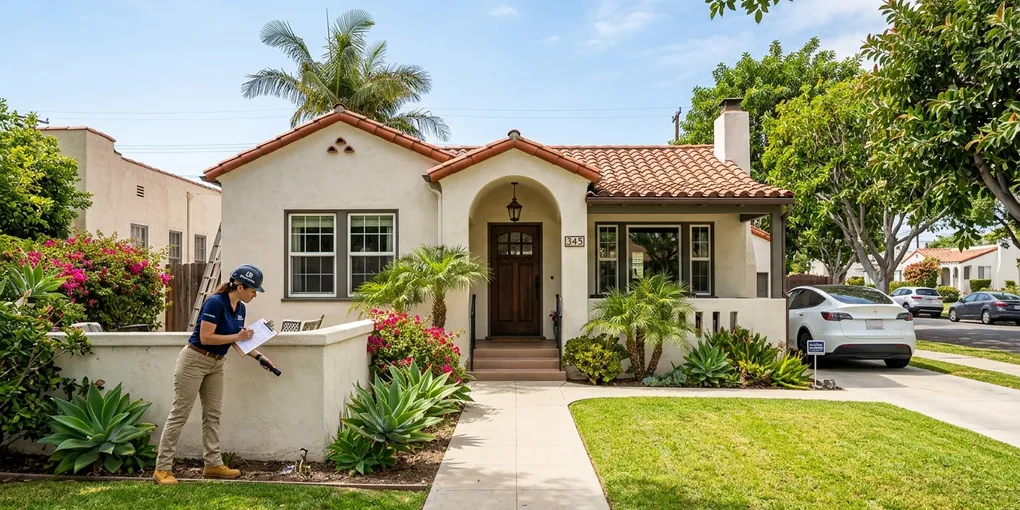
The Ultimate Guide to Spotting Roof Damage in Long Beach Real Estate Disclosures
Long Beach stands out as one of Southern California’s most vibrant coastal enclaves. From the picturesque canals and waterfront estates of Naples and Belmont Shore to the stately Craftsman and Spanish Colonial Revival homes of Bluff Heights, California Heights, and historic Bixby Knolls, Long Beach offers an eclectic blend of coastal beauty and architectural heritage.
Yet, behind the ocean breezes and swaying palms lies an aggressive, unseen adversary: the Southern California coastal marine environment subjects residential roofs to severe, continuous degradation.
With its proximity to San Pedro Bay and the Pacific Ocean, Long Beach experiences dense morning marine layers (“June Gloom”), salt-laden sea air, intense midday ultraviolet radiation, and occasional torrential winter atmospheric rivers. Because architectural styles in Long Beach heavily favor low-slope flat roofs on mid-century moderns or heavy clay barrel tiles on Mediterranean estates, severe moisture penetration and structural rot are frequently concealed from plain sight.
Local real estate attorneys and buyer’s brokers regularly see how buyers navigateed numerous buyers blindsided by catastrophic roofing bills within months of closing. In this comprehensive guide, we unpack the mechanics of coastal roof deterioration in Long Beach, analyze California’s Transfer Disclosure Statement (TDS) and Seller Property Questionnaire (SPQ), and demonstrate how to read between the lines of real estate disclosures to protect your hard-earned equity.
The Engineering of Coastal Roof Degradation in Long Beach
Evaluating a Long Beach property requires an understanding of how marine proximity and regional architectural designs create hidden structural vulnerabilities.
Marine Layer Salt Fog and Galvanic Corrosion
Long Beach is defined by its coastal microclimate. Moisture-laden ocean fog rolls inland nearly every evening and lingers well into midday:
- Salt-Aerosol Deposition: Coastal air carries microscopic sodium chloride particles. As marine fog condenses and evaporates on roof surfaces, salt concentrates on metal flashing, drip edges, fasteners, and valley liners.
- Fastener Rust and Wind Lift: Uncoated galvanized roofing nails rust prematurely from the salt spray. As fasteners corrode and lose their grip on underlying plywood or tongue-and-groove decking, asphalt shingle tabs and tile ties detach during gusty coastal storm fronts.
- Electrolytic Flashing Breakdown: Where dissimilar metals meet—such as copper valley pans contacting galvanized valley flashings or steel plumbing vents—salt moisture acts as an electrolyte, accelerating galvanic corrosion that eats pinholes into water barriers.
Spanish Tile and the “Underlayment Mirage”
Throughout historic neighborhoods like Belmont Heights and Carroll Park, 1920s Spanish Revival homes feature timeless red clay barrel tiles:
- Indestructible Tiles vs. Perishable Felt: While terra cotta clay tiles can easily endure for 80 to 100 years, the waterproof asphalt-saturated felt underlayment underneath has an effective lifespan of only 20 to 25 years.
- The Visual Trap: A roof can appear pristine from street level with classic, unblemished curved tiles. Beneath those tiles, however, thirty years of thermal baking and trapped coastal moisture reduce organic felt paper to brittle, brittle charcoal that flakes away.
- Broken Water channels: When tile mortar packs (birdstops) crack at eaves and ridges, coastal moisture and wind-driven rain seep beneath the tiles, flowing directly across deteriorated felt into the structural roof deck.
Mid-Century Flat Roofs and Parapet Drainage Ponding
From the iconic Cliff May “Rancho” homes in East Long Beach to mid-century moderns in Los Cerritos, flat and low-pitch roofs are ubiquitous:
- Ponding Water and UV Deterioration: Flat roofing systems (torch-down modified bitumen, built-up tar-and-gravel, or single-ply TPO) rely on subtle slopes toward perimeter scuppers or internal drains. Over decades, wood foundation settling creates low spots where water ponds for days after winter rainstorms.
- Seam Delamination: Constant standing water dissolves asphalt binders and breaks down adhesive seams on modified bitumen membranes. Combined with intense coastal UV rays, the surface blisters, cracks (known as “alligatoring”), and permits slow, silent water ingress.
Tired of manually reading 200-page disclosures?
Let DisclosurePro AI scan your documents for hidden termite damage, structural issues, and unpermitted work in 10 seconds. Try it free today.
California Real Estate Disclosure Laws: The TDS and SPQ Decoded
California maintains some of the most rigorous consumer-protection disclosure statutes in the nation, yet loopholes and vague answers still catch unsuspecting buyers off guard.
The Real Estate Transfer Disclosure Statement (TDS)
Codified in California Civil Code § 1102, the statutory Real Estate Transfer Disclosure Statement (TDS) is a non-waivable requirement in standard residential sales:
- Section II.A – Structural Components: The seller must affirmatively check boxes indicating whether the property includes items such as a roof, gutters, and downspouts, and must identify the approximate roof age.
- Section II.B – Known Defects: The seller must explicitly answer whether they are aware of any significant defects or malfunctions in the “Roof(s)” or “Windows/Doors.”
- Section II.C – Legal and Environmental Issues: Inquires about past water intrusions, settling, unpermitted remodeling, or insurance claims.
The Seller Property Questionnaire (SPQ)
Used in conjunction with the statutory TDS, the California Association of REALTORS® (C.A.R.) Seller Property Questionnaire (SPQ) drills deeper into the seller’s institutional knowledge:
- Section V.A – Water-Related Issues: The seller must disclose any history of water leaks, moisture problems, water ponding, or leaks from roofs, gutters, or skylights.
- Repairs and Alterations: The seller must provide details on any past roof maintenance, coating applications, or patch jobs performed during their ownership.
The “Actual Knowledge” Standard and the “As-Is” Misconception
Many California sellers mistakenly believe that listing a home “As-Is” relieves them of disclosure obligations:
- Under California law, an “As-Is” clause merely indicates that the seller will not perform repairs; it does not excuse the seller from disclosing known latent material defects.
- However, sellers are only liable for disclosing defects of which they have actual knowledge. If an investor acquired a flipped property in North Long Beach through probate or foreclosure, they often provide an exempt disclosure or mark “No” to past leaks, claiming they never occupied the premises.
- Furthermore, sellers who hired an unlicensed handyman to spread silicone mastic or tar over a roof leak will frequently check “No known leaks,” rationalizing that their temporary fix solved the problem permanently.
Evasive Phrasing in Long Beach Seller Disclosures
When parsing through Section II of the TDS or the SPQ, look out for these telltale euphemisms:
- “Spanish tile roof serviced and tuned-up prior to listing” — Often means broken tiles were mortared together and cracked vents caulked, while the 35-year-old failing underlayment underneath was completely ignored.
- “Flat roof recoated with elastomeric sealant in 2023” — A classic stopgap measure used to postpone an expensive full tear-off and deck replacement.
- “Minor condensation noted near skylight during heavy winter rains” — Frequently downplays a structural leak where water is running along framing headers.
- “Seller has no knowledge; buyer to satisfy themselves through independent inspection” — A standard disclaimer used by trust administrators and flippers that demands heightened scrutiny.
The Manual Review Problem: Navigating the California Contingency Timeline
Under the standard C.A.R. California Residential Purchase Agreement (RPA), buyers typically have a 17-day Buyer Investigation contingency period (unless negotiated down to 7 or 10 days in competitive bidding wars).
Within this tight window, a homebuyer must review and synthesize:
- The 3-page statutory Real Estate Transfer Disclosure Statement (TDS).
- The multi-page Seller Property Questionnaire (SPQ).
- The 40-to-60-page general home inspection report.
- City of Long Beach Development Services permit history to verify whether reroofing permits were pulled and finaled.
- Invoices, contractor warranties, and historical maintenance receipts.
Most general home inspectors will explicitly decline to walk on fragile Spanish clay tiles or wet foam flat roofs, stating in their reports: “Clay tiles are fragile and prone to breakage; inspected from eaves and binoculars only.” Visual evaluations from ground level cannot detect rotted sub-decking, split underlayment, or rusted valley flashing. If a buyer rushes through hundreds of pages of disclosure addenda, they risk missing critical acknowledgments of past water intrusion.
Financial Impact: A Real-World Belmont Shore Mediterranean Case Study
To understand how an overlooked disclosure note can translate into crippling financial loss, consider this realistic scenario from Long Beach’s Belmont Shore neighborhood.
The Transaction
David and Chloe purchased a gorgeous 1932 Spanish Colonial Revival home two blocks from Alamitos Bay for $1,280,000. The home boasted architectural elegance: original Batchelder tile, arched doorways, and authentic two-piece clay barrel roof tiles.
On the TDS and SPQ, the seller checked “No” to roof defects and added a short handwritten note: “Tile roof professionally maintained; annual tile maintenance completed November 2024.” The general home inspector inspected the roof from a tall ladder at the gutter line, noting: “Tile roof appears well-maintained with minimal cracked tiles visible from perimeter.” Feeling confident, David and Chloe removed their contingencies and closed the deal.
The Atmospheric River
Fourteen months later, a massive atmospheric river stalled over Los Angeles County, dumping 5.5 inches of wind-whipped rain over Long Beach in 48 hours.
Water began pooling on the ceiling of the second-story primary bedroom and weeping behind the historic plaster walls in the entryway. When a licensed California C-39 roofing contractor pulled back several courses of clay tiles, the catastrophic truth was revealed:
- The original asphalt felt underlayment was over 30 years old, completely desiccated, and split into brittle fragments.
- The seller’s “annual maintenance” consisted of an unlicensed laborer sealing broken tile gaps with silicone caulking and repainting mortar without replacing deteriorated felt.
- Decades of coastal salt moisture that seeped under the tiles had corroded every galvanized nail into dust, causing tiles to slide out of alignment.
- Water intrusion had rotted out 350 square feet of tongue-and-groove roof sheathing and heavily degraded the underlying 2x6 redwood rafters.
The Financial Devastation
Because the seller technically mentioned “maintenance” and claimed they had no actual knowledge of leaks beneath the tiles, proving intentional fraud in arbitration proved legally prohibitive. David and Chloe were forced to absorb the reconstruction expenses directly:
| Expense Item | Cost |
|---|---|
| Careful removal, salvage, and palletizing of historic clay barrel tiles | $8,800 |
| Disposal of non-salvageable broken tiles and rotted underlayment | $2,400 |
| Structural sistering and repair of rotted redwood roof rafters | $7,600 |
| Replacement of damaged tongue-and-groove roof decking with CDX plywood | $5,200 |
| Installation of high-temp dual-layer modified bitumen underlayment | $6,400 |
| Re-installation of salvaged clay tiles and blending with matching vintage tiles | $14,200 |
| Custom copper flashing, valley pans, and eave metal fabrication | $4,800 |
| Interior lath-and-plaster historic restoration and mold abatement | $6,500 |
| City of Long Beach building permits, plan check, and inspection fees | $950 |
| Total Financial Loss | $56,850 |
Frequently Asked Questions about Roof Issues in Long Beach
1. How long does a Spanish tile roof underlayment last in Long Beach?
While the clay or concrete tiles themselves can last 75 to 100 years, the waterproof underlayment beneath them typically lasts only 20 to 25 years in coastal Long Beach. Marine salt air, morning condensation, and high summer UV radiation cause organic felt underlayment to dry out, crack, and fail long before the tiles show any visual wear.
2. Can a Long Beach seller be held liable if the roof leaks right after closing?
Under California law, a seller is only liable if they had actual knowledge of the roof leak or structural defect and intentionally or negligently failed to disclose it on the Transfer Disclosure Statement (TDS). If the seller never experienced an active leak or honestly believed prior repairs fixed the issue, recovering damages in court or arbitration requires establishing proof of intentional concealment.
3. What is a “tile lift and relay” in Southern California?
A “lift and relay” (or “tile reset”) is a comprehensive roofing procedure where existing clay or concrete tiles are carefully removed and set aside. Roofers strip away the deteriorated underlayment, inspect and repair any rotted wood decking, install modern high-performance underlayment and new copper or galvanized flashings, and then reinstall the original tiles. This restores total waterproofing while preserving the home’s historic architectural aesthetics at roughly half the cost of brand-new imported tiles.
4. Are flat roofs common in Long Beach, and what are their biggest failure points?
Yes, flat and low-pitch roofs are extremely prevalent on mid-century modern residences, coastal duplexes, and multi-family properties throughout Long Beach. Their primary points of failure include ponding water caused by structural settling, clogged parapet scuppers and downspouts, and cracking or shrinkage along seam joints in torch-down modified bitumen membranes due to intense coastal UV exposure.