
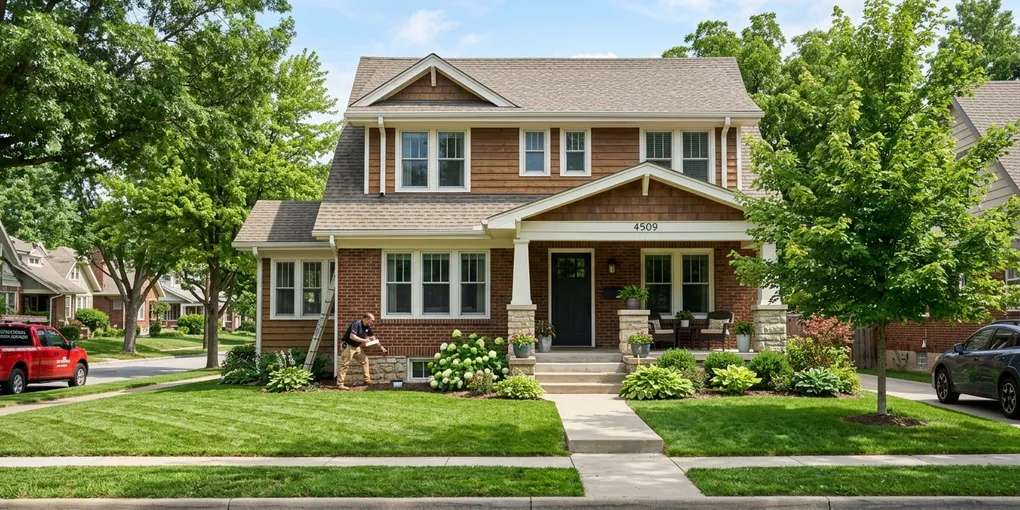
The Ultimate Guide to Spotting Roof Damage in Kansas City, MO Real Estate Disclosures
From the graceful, tree-lined boulevards of Brookside and the stately tudors of the Country Club District to the historic brick shirtwaists of Hyde Park and charming craftsman bungalows in Waldo, Kansas City boasts some of the most distinctive residential architecture in the American Midwest. Homebuyers flock to the City of Fountains for its vibrant cultural fabric, historic neighborhoods, and relatively accessible real estate market.
However, beneath the architectural charm of Kansas City homes lies a chronic, high-stakes vulnerability: the brutal climate of the lower Missouri River valley inflicts severe, relentless punishment on residential roofs.
Situated squarely in the heart of the Midwestern “Hail Alley” and subjected to dramatic seasonal temperature swings, Kansas City properties endure everything from softball-sized hail and tornadic thunderstorm wind shear in the spring to sub-zero freeze-thaw cycles and heavy ice damming in the winter. Because roofs are often steep, complex, or partially obscured by mature oak and maple canopies, catastrophic roof deterioration is easily masked or downplayed during open houses.
Local real estate attorneys and buyer’s brokers regularly see how buyers navigaten far too many buyers sign away their rights because they failed to properly decode the seller’s disclosure statement. In this comprehensive guide, we examine the physics of Kansas City roof degradation, break down Missouri disclosure law and the Missouri Realtors (MAR) DSC-8000 form, and provide actionable strategies to protect your financial future.
The Engineering of Roof Degradation in the Kansas City Metro
To uncover hidden roof issues before closing, you must understand the interplay between Kansas City’s weather extremes and its historic residential housing stock.
Hail Alley Convective Storms and Granule Loss
Kansas City sits directly in the crosshairs of severe Midwestern storm corridors where dry Rocky Mountain air collides with warm, humid moisture flowing northward from the Gulf of Mexico:
- Impact Fractures and Bruising: Hailstones larger than an inch fall at terminal velocities exceeding 50 to 70 mph. When they impact asphalt shingles, they do not always punch obvious holes; instead, they fracture the underlying fiberglass mat. This is known as “shingle bruising.” The protective ceramic granule coating is dislodged, leaving the underlying bitumen binder directly exposed to ultraviolet degradation.
- Micro-Fissures and Latent Leaks: Once granules are stripped away, the asphalt membrane quickly dries out, curls, and cracks under summer temperatures that regularly climb into the upper 90s. While a roof may not leak the day after a hail event, water penetration typically starts 12 to 24 months later as deteriorated shingles break apart.
Winter Ice Dams and Freeze-Thaw Thermal Shock
Winter in Jackson and Clay counties presents an entirely different structural threat to roofing systems:
- Attic Heat Loss and Ice Dam Formation: Kansas City’s older architectural gems—such as 1920s shirtwaist colonials and stone Tudors—often suffer from inadequate attic insulation and poor soffit-to-ridge ventilation. Snow accumulating on the roof melts from interior heat rising into the attic rafters. The liquid meltwater runs down the slope until it reaches the cold, uninsulated eaves and gutters, where it flash-freezes into a solid ridge of ice.
- Hydrostatic Back-Up: As subsequent snow melts, trapped water pools behind the ice dam. Because standard asphalt shingle slopes are designed to shed water downward by gravity rather than resist standing water, the pooled water forces its way underneath the shingle tabs, saturates the roof deck sheathing, and rots out rafter tails while infiltrating exterior wall cavities.
Complex Multi-Gable Architecture and Valley Bottlenecks
Kansas City’s historic neighborhoods feature intricate roof geometries:
- Steep Pitches, Turrets, and Valleys: Many homes in the Country Club Plaza perimeter, Rockhill, and Sunset Hill incorporate multi-level rooflines with intersecting valleys, cricket transitions, and masonry chimneys.
- Debris Dams: The metro area’s lush canopy of pin oaks, sweetgums, and silver maples constantly deposits leaves and twigs into metal roof valleys. This organic debris traps moisture, promotes moss and fungal growth, and prematurely rusts out galvanized valley flashings.
Tired of manually reading 200-page disclosures?
Let DisclosurePro AI scan your documents for hidden termite damage, structural issues, and unpermitted work in 10 seconds. Try it free today.
Missouri Real Estate Disclosure Laws: MAR Form DSC-8000 Deconstructed
Missouri real estate legal doctrine has historic roots in caveat emptor (“let the buyer beware”). However, state statutes, common-law fraud doctrines, and standardized association forms place distinct legal burdens on home sellers.
The Missouri Association of REALTORS® (MAR) DSC-8000
In Jackson, Clay, Platte, and Cass counties, most residential transactions utilize MAR Form DSC-8000 (Seller’s Disclosure Statement for Residential Property):
- Section 2 – Roof, Gutters, and Downspouts: The seller is required to declare the age of the roof covering, whether they have experienced roof leaks during their ownership, the date of any past repairs, and whether any insurance claims for wind or hail damage have been filed.
- Layering and Decking: The form asks if there is more than one layer of shingles on the roof (an important structural consideration, as local building codes strictly limit roof overlays).
- Transferable Warranties: Sellers must disclose whether manufacturer or contractor warranties exist and if documentation is available for transfer.
The “Actual Knowledge” Doctrine and Caveat Emptor
While Missouri courts require sellers to disclose known material latent defects that a reasonable inspection would not discover, sellers are not legally bound to perform their own roof inspections before listing:
- If a homeowner has never climbed onto their steep two-story roof, they can honestly check “Unknown” regarding hail impact or granule loss.
- Out-of-state investors and corporate LLCs flipping distressed properties in Midtown or the Historic Northeast frequently provide an exempt disclosure or check “Do Not Know” across every single category.
- When sellers apply cosmetic touch-up paint over water-stained plaster ceilings, they may claim they believed an earlier patch “permanently solved” the issue, asserting lack of actual knowledge regarding ongoing active leakage.
Deceptive and Evasive Language in Kansas City Disclosures
When reviewing MAR Form DSC-8000, watch out for these commonly used phrases:
- “Roof inspected after recent storm; no active leaks found” — Often means an unlicensed roofer performed a courtesy look without certifying the underlying decking or membrane integrity.
- “Minor cosmetic hail pings on gutters” — A major warning sign that severe hail struck the property; if soft metal downspouts are dented, the brittle shingles overhead almost certainly suffered impact bruising.
- “Second layer installed in 2018 for extra protection” — “Overlaying” or installing shingles over old shingles traps heat, accelerates shingle deterioration, adds massive dead-weight loads to aging rafters, and voids most manufacturer warranties.
- “Prior leak repaired by previous owner” — Shifts liability backward, leaving the buyer with no recourse against the current seller if the repair failed.
The Manual Review Problem: Navigating the Missouri Inspection Window
Under the standard Missouri Residential Real Estate Sale Contract, buyers typically receive a 10-day Inspection Period (the “Due Diligence Period”).
During this brief 10-day window, a homebuyer must coordinate:
- The comprehensive MAR Seller’s Property Disclosure Statement.
- The 50-to-70-page general home inspection report.
- City of Kansas City, Missouri (KCMO) Compass permit portal records to determine whether previous roof tear-offs had required building permits pulled and passed final inspection.
- Past homeowner insurance claim histories (via a CLUE report) to see if an insurance payout was received for a hail claim that was never actually spent on a roof replacement.
- Invoices and material warranties from local roofing contractors.
Home inspectors frequently include disclaimers in their reports, noting: “Roof pitch exceeds safety limits; visual examination conducted from ground level with binoculars or drone.” Ground-level views cannot detect delaminated shingle tabs, soft spots in wood sheathing, or split valley flashings. If a buyer misses a single cryptic disclosure line—such as “chimney flashing caulked 2023”—they may unknowingly inherit tens of thousands of dollars in hidden framing rot.
Financial Impact: A Real-World Waldo Bungalow Case Study
To see how an overlooked disclosure phrase can cause financial havoc, examine this realistic scenario from Kansas City’s Waldo neighborhood.
The Purchase
Mark and Sarah purchased a restored 1928 Craftsman bungalow near 75th and Wornall for $365,000. The property featured original hardwood floors, restored millwork, and a newly painted exterior.
On the MAR Form DSC-8000, under Section 2, the seller noted: “Roof age approx. 8 years. Minor leak near chimney flashing repaired in 2024. No current leaks.” The general inspector, unable to walk the steep 10/12 pitch due to light rain on inspection day, observed the roof from the driveway and noted: “Asphalt shingles appear visually intact with normal granule weathering.” Satisfied, Mark and Sarah closed.
The Spring Supercell
Six months later, in April, a severe severe thunderstorm swept across Jackson County, dropping 2 inches of wind-driven rain and nickel-sized hail in forty-five minutes.
Water began cascading through the ceiling of the master bedroom closet and around the living room fireplace mantel. When a licensed Kansas City roofing contractor removed the shingles surrounding the chimney, the full scope of hidden decay was laid bare:
- The seller’s “2024 repair” was simply a thick slathering of black roofing tar over severely rusted, corroded step flashing.
- The roof had never been fully torn off in 2016 as implied; instead, a second layer of architectural shingles had been nailed directly over 25-year-old 3-tab shingles and original 1-inch pine plank decking.
- Decades of chronic minor leakage around the un-cricketed chimney had turned four adjacent rafters and six linear feet of exterior wall framing into spongy, fungal-infested dry rot.
- The structural framing was on the verge of sagging under the weight of the double shingle layers.
The Financial Devastation
Because the seller’s disclosure referenced a “repair,” the seller argued they disclosed the condition honestly and believed it was sound. Mark and Sarah had to fund the structural rebuild out-of-pocket:
| Expense Item | Cost |
|---|---|
| Complete double-layer tear-off and haul-away disposal | $5,200 |
| Sistering and structural replacement of rotted Douglas fir rafters | $6,400 |
| Replacement of compromised 1x8 pine board decking with 5/8“ CDX plywood | $3,800 |
| Custom chimney cricket fabrication, lead counter-flashing, and ice & water shield installation | $2,900 |
| Class 4 Impact-Resistant Architectural Shingle installation (50-year system) | $13,400 |
| Living room plaster ceiling stabilization, drywall repair, and insulation replacement | $4,500 |
| KCMO residential building permits and structural inspection fees | $650 |
| Total Out-of-Pocket Expense | $36,850 |
Frequently Asked Questions about Roofs in Kansas City
1. How does the Kansas City climate affect roof lifespan?
While modern architectural shingles are marketed as 30-year products, the actual lifespan in Kansas City averages 15 to 20 years. Frequent freeze-thaw cycles, violent hail impacts, and high summer humidity cause accelerated granule loss and thermal shock, dramatically shortening service life compared to milder climates.
2. Can a seller in Kansas City legally put a second layer of shingles over an old roof?
Under the Kansas City, Missouri building code (which adopts the International Residential Code), a maximum of two layers of asphalt shingles is legally permitted. However, most structural engineers and reputable roofers strongly advise against overlays in the Midwest because they trap excess attic heat, hide rotted decking, and add substantial weight that can stress older framing during heavy winter snowloads.
3. What is a Class 4 impact-resistant shingle, and is it necessary in Kansas City?
Class 4 shingles are specifically engineered to withstand impacts from two-inch steel balls dropped from 20 feet without cracking the underlying fiberglass mat. Given Kansas City’s frequent severe hail storms, installing Class 4 shingles is highly recommended and often qualifies homeowners for substantial annual premium discounts (ranging from 10% to 25%) on their Missouri hazard insurance policies.
4. What is the difference between step flashing and counter flashing on a Kansas City brick chimney?
Step flashing consists of individual L-shaped metal pieces woven between each course of shingles along the side of the chimney wall. Counter flashing is metal embedded directly into the mortar joints of the brick masonry that hangs down to cover the top of the step flashing. In older Kansas City brick homes, deteriorating mortar causes counter flashing to pull away, allowing wind-driven rain to enter the attic unseen.