
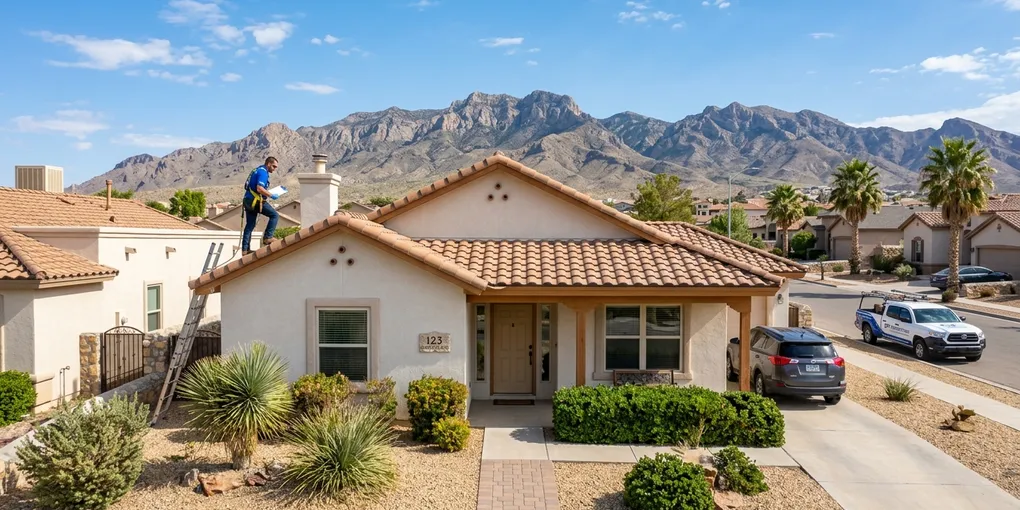
The Ultimate Guide to Spotting Roof Damage in El Paso Real Estate Disclosures
El Paso holds a unique and captivating place in the Texas real estate market. Nestled in the dramatic Franklin Mountains where Texas, New Mexico, and Mexico converge, the “Sun City” is celebrated for its rich cultural history, scenic desert vistas, and distinctive architectural heritage. From the historic Spanish Colonial Revival and Craftsman homes of Sunset Heights and Kern Place to the hillside estates of Coronado and Mesa Hills, through to sprawling modern family developments in East El Paso, the city offers homebuyers extraordinary character and value.
However, behind El Paso’s picturesque stucco facades, clay tile accents, and panoramic mountain views lies an unforgiving desert environment that relentlessly attacks residential structures: extreme desert roof degradation.
Situated deep within the Chihuahuan Desert, El Paso experiences over 300 days of blistering sunshine, summer temperatures routinely surpassing 105°F, fierce spring windstorms carrying abrasive desert sand, and violent summer monsoon cloudbursts. Under these harsh desert dynamics, residential roofs—particularly low-slope flat roofs with parapet walls and traditional asphalt shingles—deteriorate at an accelerated pace. Overlooking vague phrases or calculated omissions in a Texas Seller’s Disclosure Notice can leave an unsuspecting homebuyer facing tens of thousands of dollars in emergency structural repairs.
As a practicing Texas real estate attorney and active El Paso broker, I routinely guide buyers through high-stakes residential transactions where an unexamined roofing red flag threatens to turn an investment into a financial nightmare. In this comprehensive guide, we dissect the mechanics of Chihuahuan Desert roof failures, examine Texas statutory disclosure laws, and expose the subtle red flags sellers use to mask failing roofs.
The Anatomy of El Paso Roof Damage: Desert UV, Sandstorms, and Monsoon Deluges
Evaluating a property in El Paso County requires a firm grasp of how intense arid climatic forces degrade local roofing assemblies.
High-Intensity UV Radiation and Bitumen Volatilization
In the Chihuahuan Desert, the solar radiation index is among the highest in North America:
- Asphalt Desiccation: Roof surface temperatures in El Paso routinely reach 160°F to 175°F during summer heatwaves. This extreme heat bakes the volatile petroleum oils out of asphalt shingles and modified bitumen flat roof membranes. As these oils evaporate, the materials lose elasticity, becoming chalky, brittle, and highly prone to micro-cracking.
- Thermal Movement and Seam Delamination: The desert experiences sharp day-to-night temperature drops (often shifting 35°F in a few hours). This rapid thermal cycling strains membrane seams on low-slope roofs, breaking heat-welded joints and pulling roofing nails through brittle shingle mats.
Spring Wind and Sandstorm Abrasion
Between March and May, El Paso experiences powerful westerly winds with sustained gusts exceeding 50 to 60 miles per hour, funneling through mountain passes:
- Sandblasting Effect: These severe winds lift fine desert grit and sand, effectively sandblasting roof planes. The abrasive sand knocks protective ceramic granules off asphalt shingles, directly exposing the fragile fiberglass substrate.
- Wind-Uplift and Tab Tearing: High desert wind gusts generate powerful negative pressure across roof edges and eaves, tearing unsealed shingle tabs and lifting metal flashing along parapet walls.
Monsoon Cloudbursts and Low-Slope Parapet Drainage Failures
A substantial portion of El Paso homes—particularly Southwestern Pueblo and Spanish Revival styles—utilize low-slope flat roofs enclosed by parapet walls:
- Clogged Canales and Scupper Drains: Precipitation in El Paso is heavily concentrated during the July and August North American Monsoon. When a torrential storm dumps two inches of rain in forty-five minutes, water rushes toward perimeter scuppers and decorative drain spouts (canales). If these drains are obstructed by windblown desert dust and debris, water quickly pools into expansive ponds.
- Parapet Flashing Breaches: Standing water exerts immense hydrostatic pressure against parapet wall base flashing. When flashing cracks under desert heat, water flows directly into exterior adobe or stucco walls, rotting structural timber vigas and ceiling joists unseen.
Tired of manually reading 200-page disclosures?
Let DisclosurePro AI scan your documents for hidden termite damage, structural issues, and unpermitted work in 10 seconds. Try it free today.
Navigating Texas Real Estate Disclosure Laws in El Paso
In the Lone Star State, residential property transactions are governed by stringent statutory disclosure obligations and strong consumer-protection legal doctrines.
Texas Property Code § 5.008 and the Seller’s Disclosure Notice
Under Texas Property Code § 5.008, a seller of a single-family residential property must provide a statutory Seller’s Disclosure Notice (standardized via Texas REALTORS® Form TXR-1406 or TREC Form OP-H).
The Texas disclosure notice specifically interrogates the seller regarding the roof:
- Item 1: “Roof Type, Age, and Shingle/Membrane Covering”
- Item 4: “Are you aware of any current or previous defects in the roof, including active leaks, previous repairs, or ponding water?”
- Item 4 (Structural): “Are you aware of any structural repairs, water penetration, or unpermitted additions?”
If the seller fails to deliver this completed notice prior to contract execution, Texas Property Code § 5.008(f) grants the buyer the absolute statutory right to terminate the contract for any reason within seven days of receiving the notice and receive their full earnest money back.
The Texas Deceptive Trade Practices Act (DTPA)
Texas law takes fraudulent real estate representations very seriously. Under the Texas Deceptive Trade Practices-Consumer Protection Act (DTPA, Tex. Bus. & Com. Code § 17.46):
- A seller who knowingly conceals a material latent defect, makes a false statement of fact, or fails to disclose known defect information to induce a purchase commits an actionable violation.
- If the misrepresentation was committed “knowingly” or “intentionally,” an injured buyer can sue for up to three times their actual economic damages (treble damages), plus court costs and reasonable attorney fees.
Evasive Tactics Used by El Paso Sellers
Despite rigorous DTPA protections, sellers and flippers frequently attempt to sidestep disclosure liability through careful, ambiguous language:
- “Elastomeric white roof coating applied in 2024” (deliberately disguising that the reflective paint was rolled over severely blistered bitumen and rotten wood decking without fixing active leaks).
- “Roof inspected annually; canales cleared” (masking chronic monsoon ponding and decayed parapet counter-flashing).
- “Minor leak around evaporative cooler duct repaired in 2023” (ignoring widespread rafter rot beneath the swamp cooler platform).
- “Seller is an heir/investor and has never occupied property” (used to mark ‘Unknown’ across all critical structural condition items).
The Manual Review Problem: Drowning in El Paso Due Diligence
Under the standard Texas Real Estate Commission (TREC) One to Four Family Residential Contract (Resale), buyers typically negotiate an Option Period lasting only 5 to 10 days.
During this brief window, the buyer pays an independent option fee for the unrestricted right to terminate the contract. Within this tight timeframe, El Paso buyers must review an extensive collection of dense documents:
- The 6-to-8 page Texas Seller’s Disclosure Notice.
- The City of El Paso Planning & Inspections Department permit history.
- The general TREC-mandated physical home inspection report (often 50 to 75 pages).
- Evaporative cooling (swamp cooler) mechanical inspection reports and roof mount evaluations.
- Title commitments detailing shared parapet easements and boundary agreements.
Catastrophic roofing red flags are easily lost in technical report jargon. For example, a home inspector might include a single line on page 43: “Observed localized efflorescence and stucco spalling along exterior parapet wall beneath rear scupper.” To a first-time buyer, this sounds like minor cosmetic stucco peeling. In reality, in El Paso, that efflorescence is clear proof that monsoon rainwater has been trapped behind the stucco for months, silently rotting the underlying timber vigas and ceiling framing.
Financial Impact: A Real-World Kern Place Case Study
To see how disastrous an unvetted roof disclosure can be in El Paso, consider this realistic scenario from a historic home acquisition in Kern Place.
The Purchase
Mateo and Camila purchased a 1938 Spanish Colonial Revival home in Kern Place for $465,000. The residence featured a distinctive combination of decorative red clay tile accents over the front porch and a low-slope modified bitumen roof behind stucco parapet walls.
On the Texas Seller’s Disclosure Notice, the seller answered “No” to active roof leaks and wrote under Item 1: “Roof recoated with commercial reflective elastomeric coating in 2023; roof in good working condition.” Mateo and Camila hired a home inspector, who climbed a ladder to the parapet line. The inspector observed a bright, clean white coated surface and noted in his report: “Roof coating appears fresh; no active water staining observed on interior plaster ceilings.” Satisfied, Mateo and Camila allowed their option period to expire and finalized the purchase.
The Disaster
The following August, a severe Chihuahuan Desert monsoon storm struck El Paso, dropping 3.2 inches of torrential rain in under two hours.
Within minutes, water began cascading through the vintage plaster cove molding in the formal dining room and dripping into the living room ceiling fan. Mateo called a licensed El Paso commercial and residential roofing contractor, who cut open a test core of the roof assembly and discovered catastrophic concealed damage:
- The 2023 “coating” was an unpermitted cosmetic cover-up. The seller had applied a cheap elastomeric paint directly over a failing 25-year-old built-up roof that had suffered extensive seam splitting.
- The decorative canales were improperly pitched, allowing over three inches of water to pool behind the rear parapet wall.
- Water had penetrated behind the parapet counter-flashing, completely rotting out the historic timber roof decking and structural cedar vigas.
- Heavy moisture had saturated the exterior adobe-and-wood framing, triggering extensive fungal dry rot and severe wall cracking that compromised the home’s structural stability.
The Financial Devastation
Because the seller had conveyed the property through an out-of-state LLC that was dissolved shortly after closing, pursuing recovery under the DTPA was financially impractical. Mateo and Camila had to fund extensive structural rebuilding immediately:
| Expense Item | Cost |
|---|---|
| Emergency water extraction and industrial dehumidification | $3,100 |
| Hazardous tear-off and disposal of rotted built-up roofing layers | $11,500 |
| Structural timber viga replacement and engineered rafter rebuilding | $16,800 |
| Installation of 3/4-inch CDX decking and tapered insulation system for drainage | $12,400 |
| Installation of commercial-grade 2-ply SBS modified bitumen roof membrane | $14,900 |
| Parapet masonry rebuilding, counter-flashing, and custom copper canales | $7,800 |
| Historic plaster cove molding restoration, interior drywall, and painting | $9,600 |
| City of El Paso structural permits and historic district review fees | $1,700 |
| Total Devastation | $77,800 |
Frequently Asked Questions about Roof Issues in El Paso
1. Does an elastomeric roof coating count as a new roof in Texas?
No. An elastomeric roof coating is a liquid-applied reflective maintenance layer, not a replacement roof. While it helps reflect harsh desert UV rays and lower cooling bills, it does not restore damaged roof decking, fix rotted structural vigas, or seal major membrane splits. If an El Paso seller claims a roof is “new” based solely on an elastomeric coating application, request copies of permits and contractor invoices to verify the underlying assembly.
2. How do roof-mounted evaporative (swamp) coolers affect roof integrity in El Paso?
Evaporative swamp coolers are common on older El Paso homes. Because they circulate water continuously, an aging or poorly maintained swamp cooler can overflow, leak corrosive minerals onto the roof membrane, and rust through support mountings. Leaks beneath swamp cooler stands frequently cause concentrated structural wood rot directly above living areas.
3. What does Texas law require sellers to disclose about past monsoon roof damage?
Under Texas Property Code § 5.008, sellers must disclose all known past and present roof defects, including past leaks, insurance claims, and repairs made following monsoon storms or hail events. Failing to disclose known historical water leaks or claiming a roof was never damaged when insurance claims were previously filed constitutes a violation of the Texas Deceptive Trade Practices Act.
4. What is the average lifespan of a flat modified bitumen roof in El Paso?
In El Paso’s extreme desert climate, an SBS modified bitumen flat roof typically lasts 12 to 16 years if properly coated and maintained. Without regular UV-reflective coatings or in situations where poor drainage allows water to pond behind parapets, flat roofs can fail in as few as 8 to 10 years.