
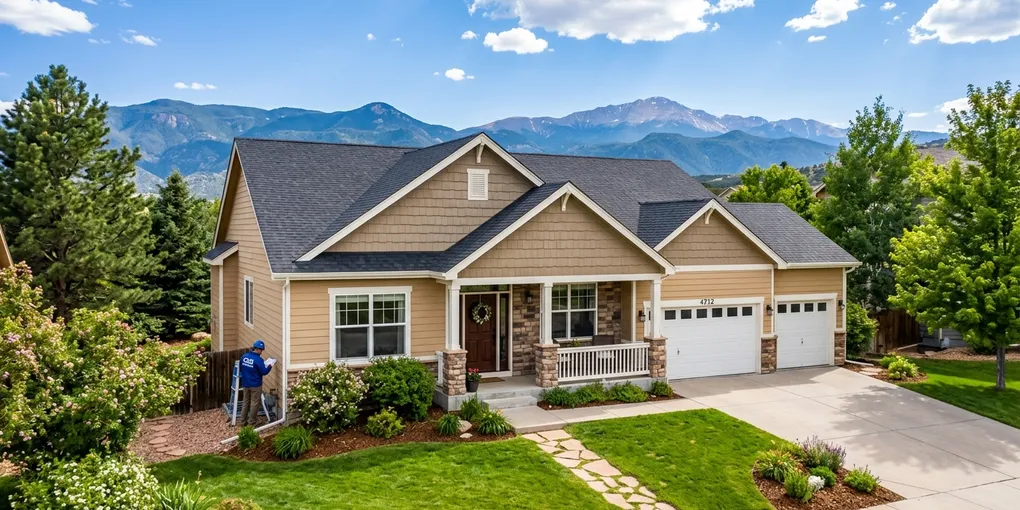
The Ultimate Guide to Spotting Roof Damage in Colorado Springs Real Estate Disclosures
Perched at the foot of America’s Mountain—Pikes Peak—Colorado Springs offers breathtaking alpine vistas, vibrant outdoor recreation, and thriving residential communities. From the historic Victorian and Craftsman manors of the Old North End and the secluded luxury estates of the Broadmoor and Cheyenne Mountain to the expansive family neighborhoods of Briargate and Rockrimmon, the Springs is one of the most desirable housing markets in the Mountain West.
However, beneath the stunning Rocky Mountain backdrop lies an extreme, relentless environmental hazard: Colorado Springs sits squarely in one of the most intense hail and severe weather corridors in North America.
Located at an altitude exceeding 6,000 feet, Colorado Springs experiences severe high-altitude ultraviolet radiation that degrades roofing materials at an accelerated pace. When combined with devastating Front Range supercell hail storms, ferocious Chinook winds gusting over 80 mph down the mountain passes, and dramatic winter freeze-thaw cycles that produce dangerous ice dams, residential roofs in El Paso County endure extraordinary physical punishment. Because roof slopes are often steep or complex, critical storm damage and decking rot are easily missed by unsuspecting buyers.
As a practicing Colorado real estate attorney and active Colorado Springs broker, I frequently witness buyers get stuck with crippling out-of-pocket roof replacement expenses because they failed to properly scrutinize the seller’s property disclosure. In this comprehensive guide, we examine the physics of Front Range roof failure, analyze Colorado disclosure laws and the CREC SPD form, and give you the legal tools to protect your investment during the inspection objection window.
The Engineering of High-Altitude Roof Degradation in El Paso County
To properly inspect a Colorado Springs home, you must understand how high-elevation weather forces degrade regional roofing materials.
Front Range Supercells and Severe Hail Impacts
The Colorado Front Range is internationally recognized by atmospheric scientists as “Hail Alley.” When cold air plunging down from the Rockies clashes with warm, moist plains air, severe supercells form directly over El Paso County:
- Kinetic Energy and Fiberglass Fracturing: Hailstones ranging from golf-ball to baseball size fall at speeds of 60 to 90 mph. Even when hail does not shatter an asphalt shingle entirely, the kinetic impact fractures the internal fiberglass reinforcing mat (known as “shingle bruising”).
- Granule Delamination: High-velocity hail scours away the ceramic mineral granules that protect the asphalt membrane from ultraviolet rays. Once exposed, the raw bitumen oxidizes and bakes under the thin alpine atmosphere, curling and cracking within 6 to 12 months.
- Metal Softness Indentations: Hail storms severely dent metal valley liners, roof vents, chimney caps, and gutter troughs, breaking caulked seams and opening conduits for water infiltration.
High-Altitude UV Baking and Rapid Thermal Cycling
Sitting more than a mile above sea level, Colorado Springs receives significantly more ultraviolet radiation than sea-level cities:
- Thin Atmosphere UV Degradation: High-altitude UV rays break down the elastomeric polymers and petroleum binders in asphalt shingles and flat roof membranes twice as fast as in coastal regions. Shingles become brittle and lose their flexibility.
- Extreme Diurnal Swings: In Colorado Springs, it is not uncommon for a sunny 65°F winter afternoon to plunge to -10°F overnight. This violent 75-degree temperature swing causes rapid expansion and contraction (“thermal shock”) of roofing materials, tearing through nail holes and breaking adhesive seal strips.
Hurricane-Force Chinook Winds and Ice Dams
- Chinook Wind Uplift: Downslope winds sweeping off Rampart Range and Pikes Peak routinely generate gusts exceeding 70 to 85 mph. These winds catch unsealed or hail-damaged shingle edges, creasing or tearing shingles off the deck entirely.
- Freeze-Thaw Ice Damming: Heavy alpine snowfalls followed by intense sunny days create severe ice dams. Heat escaping from uninsulated attics melts snow on the upper roof, which freezes as it hits cold unheated eaves. Pooled water behind the ice ridge pushes upwards beneath shingles, rotting roof sheathing and exterior walls.
Tired of manually reading 200-page disclosures?
Let DisclosurePro AI scan your documents for hidden termite damage, structural issues, and unpermitted work in 10 seconds. Try it free today.
Colorado Real Estate Disclosure Laws: CREC Form SPD-19 Explained
Colorado has progressive statutory protections requiring sellers to disclose property defects, but understanding the legal boundaries of these rules is critical.
The Colorado Real Estate Commission (CREC) Form SPD-19
In standard residential sales throughout Colorado Springs, sellers complete the CREC Form SPD-19 (Seller’s Property Disclosure - Residential):
- Section C – Roof: The seller must state the type of roof covering, the approximate age of the roof, the date the roof was last replaced or repaired, and whether there are any past or present leaks.
- Hail and Wind Damage: The seller must disclose any known damage from hail, wind, or falling debris, and whether an insurance claim was filed.
- Roof Transfers and Warranties: The seller is required to declare whether transferable warranties exist and whether roof certifications were issued.
The “Actual Knowledge” Legal Standard
Under Colorado common law and real estate licensing rules, a seller has an affirmative duty to disclose known adverse material latent defects:
- A defect is “material” if it substantially affects the value or desirability of the property.
- However, sellers are only bound by their actual knowledge. If an elderly seller has not been on their two-story roof following a June hail storm, they can honestly answer “No” to known roof defects.
- Corporate entities, investors, and foreclosing banks often check “No Knowledge” across the entire disclosure form, legally shifting the due diligence burden onto the prospective buyer.
Evasive Phrasing in Colorado Springs Disclosures
When reviewing CREC Form SPD-19, watch out for these common euphemisms:
- “Roof inspected by roofer after 2023 storm; no claim filed” — Often conceals that a storm chaser identified hail damage, but the seller didn’t want to pay their high deductible or feared insurance cancellation.
- “Insurance claim approved in 2022; minor repairs completed” — A major red flag that the seller took an insurance payout check from their carrier but only spent a fraction of it on cosmetic patching rather than replacing the roof.
- “Roof is in functional condition” — A subjective term often used to downplay a 20-year-old roof with brittle, creased shingles that will not pass an insurance underwriting inspection.
- “Wood shake roof treated with fire retardant” — Many insurance carriers in El Paso County refuse to insure untreated or aged wood shake roofs due to wildfire risk, demanding immediate replacement before issuing a policy.
The Manual Review Problem: Navigating the Colorado Inspection Objection Deadline
Under the standard Colorado Real Estate Commission approved contract (CBS1), transactions are governed by strict contractual deadlines:
- Inspection Objection Deadline: The date by which the buyer must formally deliver a list of defective items they want repaired.
- Inspection Resolution Deadline: The date by which buyer and seller must reach a signed written agreement on repairs or concessions, or the contract automatically terminates.
During this tight window (typically 7 to 10 calendar days), a homebuyer must review and analyze:
- The comprehensive CREC Seller’s Property Disclosure Statement.
- The 60-to-80-page general home inspection report.
- Pikes Peak Regional Building Department (PPRBD) online records to confirm whether past reroofs had building permits pulled and passed final mechanical inspection.
- Comprehensive Loss Underwriting Exchange (C.L.U.E.) reports detailing prior hail insurance claims.
- Roofer five-year certifications and transferable Class 4 impact warranty certificates.
General home inspectors routinely decline to climb steep two-story roofs or roofs with fragile clay tiles or steep pitches, stating: “Roof inspected via drone photography from perimeter due to safety concerns.” Ground or drone cameras cannot feel whether roof decking is spongy or check if shingle tabs have detached. If a buyer fails to catch evasive answers on the SPD-19 before the Inspection Objection Deadline passes, they forfeit their right to demand seller repairs.
Financial Impact: A Real-World Rockrimmon Hail Case Study
To understand how an overlooked disclosure note can translate into severe financial loss, examine this realistic scenario from Colorado Springs’ Rockrimmon neighborhood.
The Purchase
Tyler and Jessica purchased a 1986 multi-level home in Rockrimmon for $545,000. The property featured a vaulted cedar ceiling, a walkout basement, and mature ponderosa pines.
On the CREC Form SPD-19, under Section C, the seller marked the roof age as “Approx. 12 years,” checked “No” to active leaks, and added a short note: “Small hail claim processed 2023; gutter work completed.” The general home inspector used a drone to photograph the roof, reporting: “Asphalt shingles appear visually intact with typical age-related granule wear.” Tyler and Jessica accepted the condition and closed on the home.
The Next Storm and Insurance Denial
Eight months later, when renewing their homeowner insurance policy following a localized storm, the insurance carrier sent an underwriter to inspect the property.
The underwriter immediately issued a notice of non-renewal, stating that the roof had unmitigated severe hail damage and was uninsurable. Tyler and Jessica called a licensed El Paso County roofing contractor, who pulled the historical PPRBD permit records and climbed the roof. The shocking truth emerged:
- In the 2023 hail storm, the previous homeowner had filed a full roof claim and received a $22,000 payout from their insurance company.
- Instead of replacing the roof, the seller kept the insurance money, paid an unlicensed handyman $1,200 to replace a dented gutter, and pocketed the rest.
- Over 70% of the architectural shingles had fractured fiberglass mats and deep hail divots that had oxidized into open holes down to the underlayment.
- Water intrusion had begun rotting the OSB decking sheathing along the north-facing eaves, and freeze-thaw ice damming had ruined the insulation over the master bedroom.
The Financial Devastation
Because the seller was an out-of-state individual who moved abroad immediately after closing, pursuing legal action for fraud was impractical and costly. Tyler and Jessica had to pay for the complete replacement out-of-pocket:
| Expense Item | Cost |
|---|---|
| Full tear-off of hail-damaged shingles and disposal fees | $4,800 |
| Replacement of 28 sheets of rotted OSB roof sheathing with CDX plywood | $3,900 |
| Installation of high-temperature Ice & Water Shield across all eaves and valleys | $2,800 |
| Class 4 Impact-Resistant Architectural Shingles installation (with high-wind certification) | $16,800 |
| Heavy-duty metal valley liners, drip edge, and hail-resistant ridge vents | $3,200 |
| Attic moisture abatement, drywall repair, and blown-in cellulose insulation | $4,200 |
| Pikes Peak Regional Building Department (PPRBD) permit and inspection fees | $480 |
| Total Devastation | $36,180 |
Frequently Asked Questions about Roof Issues in Colorado Springs
1. What is a Class 4 impact-resistant shingle, and why is it essential in Colorado Springs?
A Class 4 impact-resistant shingle is engineered to withstand impacts from a two-inch steel ball dropped from 20 feet without cracking. In El Paso County’s severe hail corridor, Class 4 shingles significantly reduce the likelihood of storm damage and typically qualify homeowners for substantial annual premium discounts (often 15% to 28%) from Colorado hazard insurance providers.
2. What is the Pikes Peak Regional Building Department (PPRBD) and why should buyers check it?
The Pikes Peak Regional Building Department (PPRBD) oversees building codes and permits for Colorado Springs and El Paso County. Any full or partial roof replacement legally requires a PPRBD building permit and a completed post-installation inspection. Buyers should search the PPRBD database to verify that prior roof replacements were properly permitted and inspected by city officials.
3. Can an insurance company cancel my policy in Colorado Springs if the roof is too old?
Yes. Many homeowner insurance carriers in Colorado will not write new policies or will dramatically increase deductibles (e.g., implementing separate 1% or 2% hail deductibles) on homes with roofs older than 15 to 20 years, or roofs with unmitigated hail damage. In extreme cases, carriers issue an immediate notice of cancellation unless the roof is completely replaced within 30 days of closing.
4. What is a “Roof Certification” in Colorado real estate?
A roof certification is a written document issued by a licensed roofing contractor stating that they have physically inspected the roof and certify it to be leak-free and structurally sound for a specified period (typically 2 to 5 years). In Colorado transactions, buyers often request a roof certification during the Inspection Objection process when a roof is approaching 15+ years of age.