
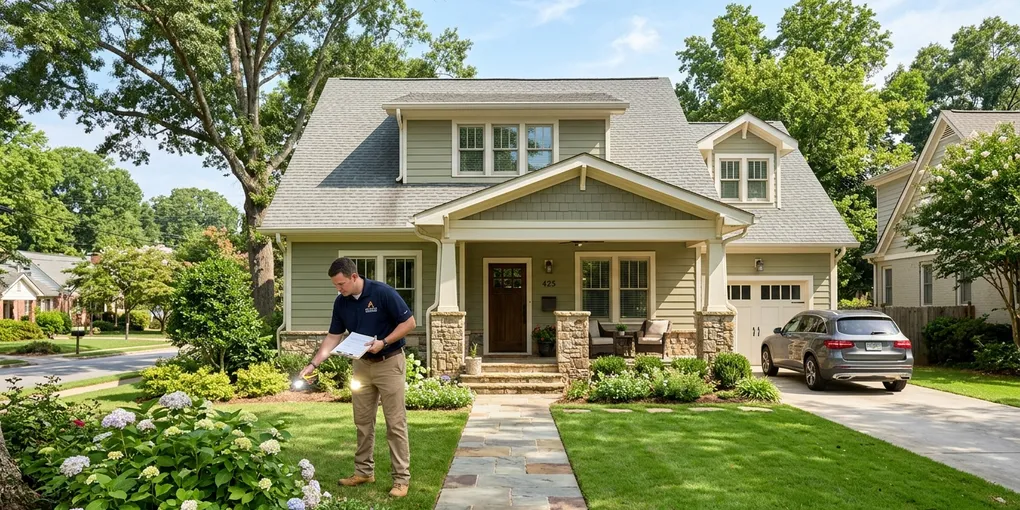
The Ultimate Guide to Spotting Roof Damage in Atlanta Real Estate Disclosures
Renowned as the “City in a Forest,” Atlanta combines southern hospitality with cosmopolitan vibrancy. From the historic Craftsman bungalows of Inman Park, Candler Park, and Virginia-Highland to the grand, wooded estates of Buckhead and Tuxedo Park, Atlanta’s residential architecture is deeply integrated into its lush tree canopy.
However, beneath Atlanta’s scenic urban forest lies a continuous, aggressive structural threat: the Piedmont climate and dense tree canopy subject residential roofs to severe, hidden deterioration.
Atlanta’s subtropical humidity, severe spring thunderstorm downpours, hurricane remnants blowing inland from the Gulf and Atlantic, and constant drop of acidic pine needles create ideal conditions for premature roof failure. Because many Atlanta homes feature steep pitches, multi-level cross-gables, and heavy shade cover, catastrophic roof decay is frequently concealed until moisture penetrates attic rafters and rots structural framing.
Local real estate attorneys and buyer’s brokers regularly see how buyers navigateed numerous buyers left facing devastating five-figure repair bills because they failed to properly decode the seller’s property disclosure. In this comprehensive guide, we dissect the mechanics of roof degradation in Fulton and DeKalb counties, examine Georgia’s caveat emptor disclosure rules and the GAR F301 form, and show you how to protect your investment during the due diligence period.
The Engineering of Roof Degradation in Atlanta’s Urban Canopy
To evaluate an Atlanta property effectively, you must understand how Georgia’s unique environment interacts with common residential roofing systems.
Pine Needle Accumulation and Acidic Debris Dams
Atlanta is blanketed by mature loblolly pines, sweetgums, water oaks, and tulip poplars:
- Debris Dams in Valleys and Behind Chimneys: Pine needles do not simply wash away with rain; they mat down into dense, sponge-like carpets in roof valleys, gutter troughs, and dead-valleys behind wide masonry chimneys.
- Acidic Wood Decay: Pine needles release organic acids as they decompose. This acidic moisture breaks down the ceramic granule coating on asphalt shingles, rusts through galvanized step flashing, and creates a perpetual moisture reservoir that rots wood decking.
- Fungal and Algae Colonization: Constant shade from Atlanta’s tree canopy prevents roofs from drying out completely. Gloeocapsa magma (blue-green algae) and moss flourish, lifting shingle edges and allowing wind-driven rain to siphon beneath the tabs.
Convective Thunderstorms, Microbursts, and Hail
Sitting in the rolling foothills of the Piedmont region, Atlanta experiences violent convective storm cells throughout the spring and summer:
- Microburst Wind Shear: Thunderstorms frequently generate sudden straight-line winds and microbursts with gusts exceeding 60 to 75 mph. These winds shear across gables, lifting unsealed shingles and breaking adhesive seal strips.
- Falling Limb Impact Fractures: When wind gusts shake mature hardwood trees, heavy dead limbs drop onto roofs. Even if a branch does not punch directly through the roof, the impact fractures the underlying roof decking and bruises shingle fiberglass mats.
- Hail Bruising: Spring storm cells in North Georgia drop severe hail that fractures the brittle asphalt substrate. Once granules are dislodged, the underlying asphalt binder oxidizes rapidly under intense July sun.
High Attic Heat, Humidity, and Thermal Blistering
Atlanta summers bring temperatures in the 90s paired with oppressive 80%+ relative humidity:
- Attic Heat Traps: In older bungalows and split-levels with inadequate soffit-to-ridge cross-ventilation, attic temperatures regularly climb to 140°F or higher.
- Thermal Blistering: Excessive radiant heat from below, combined with relentless sun from above, boils trace moisture inside the shingles, causing asphalt blisters that pop and leave unprotected craters where water penetrates during heavy downpours.
Tired of manually reading 200-page disclosures?
Let DisclosurePro AI scan your documents for hidden termite damage, structural issues, and unpermitted work in 10 seconds. Try it free today.
Georgia Real Estate Disclosure Laws: GAR Form F301 Deconstructed
Georgia is historically and legally a strict caveat emptor (“let the buyer beware”) state. However, standard contractual practice and established case law create critical disclosure requirements.
The Georgia Association of REALTORS® (GAR) Form F301
In residential transactions across Atlanta, the GAR Form F301 (Seller’s Property Disclosure Statement Exhibit) is the primary disclosure vehicle:
- Section B – Structural / Roof: The seller must disclose the approximate age of the roof, whether there are any past or present leaks, whether repairs have been performed during their ownership, and the names of contractors who performed the work.
- Insurance Claims: The seller must explicitly disclose whether any insurance claims for wind, hail, or falling tree damage have been filed on the property.
- Drainage and Gutters: Inquires whether gutters and downspouts are in working order and whether standing water accumulates on flat or low-slope sections.
The Caveat Emptor Doctrine vs. Fraudulent Concealment
Under Georgia common law, a seller is under no affirmative statutory obligation to provide a formal warranty of condition unless contractually agreed upon:
- The “Buyer Beware” Rule: The buyer is expected to exercise due diligence and inspect the property thoroughly. If a defect was discoverable by a reasonable inspection, Georgia courts will rarely grant relief to a buyer who failed to look.
- The Fraud Exception: A seller cannot fraudulently conceal known latent defects that the buyer could not have discovered through the exercise of ordinary care. If a seller covers active water stains on a tongue-and-groove ceiling with Kilz primer and checks “No leaks” on the GAR disclosure, they commit actionable fraud.
- The “Actual Knowledge” Standard: Sellers are only liable for disclosing conditions within their actual knowledge. A seller who never enters their attic crawl space can honestly claim they had no knowledge of structural deck rot.
Evasive Phrasing in Atlanta Seller Disclosures
When reviewing GAR Form F301 in the Atlanta market, watch out for these telltale phrases:
- “Roof inspected annually; blown-off shingles replaced as needed” — Indicates recurring wind-damage issues and failing adhesive tabs across the entire roof surface.
- “Small chimney leak repaired and caulked in 2024” — Masonry chimneys in Atlanta historic homes expand and contract with humidity; silicone caulking around flashing is a temporary patch, not a structural fix.
- “Roof age estimated by previous owner” — A common disclaimer that allows the seller to avoid taking legal responsibility for an end-of-life roof.
- “No active leaks during seller’s ownership” — Does not mean the roof is sound; it simply means water has not yet penetrated the living space ceiling drywall.
The Manual Review Problem: Surviving the Atlanta Due Diligence Period
Under the standard Georgia Association of REALTORS® Purchase and Sale Agreement, buyers typically negotiate a Due Diligence Period of 7 to 10 calendar days.
During this short window, the buyer must coordinate and synthesize:
- The multi-page GAR Form F301 Seller’s Property Disclosure Statement.
- The 50-to-70-page general home inspection report.
- City of Atlanta Office of Buildings or DeKalb/Fulton County permit records to see if permits were pulled for past reroofs.
- C.L.U.E. or insurance loss runs detailing prior storm damage claims.
- Invoices and material warranties from local roofing contractors.
Most general home inspectors in Atlanta will not walk roofs that exceed an 8/12 pitch or two stories in height, stating in their reports: “Due to steep pitch and wet morning dew, roof inspected from ground level with high-resolution drone.” Drones and ground cameras cannot detect spongy decking, rotted wood fascias behind gutters, or compromised step flashing buried beneath layers of pine needles. If a buyer fails to catch evasive answers on the seller’s disclosure before the Due Diligence Period expires, their earnest money deposit is completely on the line.
Financial Impact: A Real-World Virginia-Highland Bungalow Case Study
To understand the serious financial risks of an overlooked roof disclosure, consider this realistic scenario from Atlanta’s historic Virginia-Highland neighborhood.
The Purchase
Marcus and Lauren purchased a charming 1924 Craftsman bungalow on Virginia Avenue for $785,000. The home featured a wide front porch, original heart pine flooring, and a stone fireplace flanked by mature white oak trees.
On the GAR Form F301 disclosure under Section B, the seller marked the roof age as “Approx. 10 years” and checked “No” to active leaks, adding a handwritten note: “Valley flashing cleared and sealed 2024.” The general home inspector used a drone to photograph the roof, noting: “Architectural shingles appear uniform; some tree debris present in valleys.” Marcus and Lauren concluded their due diligence and closed on the purchase.
The Summer Microburst
Eight months later, in late July, a severe convective thunderstorm swept through Midtown and Virginia-Highland, dropping 3.2 inches of torrential rain with 65 mph straight-line winds in forty minutes.
Water began cascading through the ceiling of the secondary bedroom and pooling behind the stone fireplace hearth in the living room. When a licensed Georgia commercial roofing contractor cleared away dense pine needle mats and pulled back the shingles, the devastating reality was revealed:
- The roof was actually over 20 years old; a second layer of shingles had been nailed directly over deteriorated organic shingles in the early 2000s without a permit.
- The seller’s “2024 valley sealing” was a thick coat of roofing mastic applied directly over rusted, paper-thin galvanized valley metal that was rotted with holes.
- Debris dams behind the un-cricketed masonry chimney had held stagnant acidic rainwater against the wood framing for years, completely rotting out the 1x6 tongue-and-groove decking and three adjacent ceiling joists.
- Active black mold colonies had spread across 250 square feet of attic insulation and sheathing.
The Financial Devastation
Because the seller’s disclosure noted that valley work had been performed, the seller argued they made no misrepresentations and believed the repair was adequate. Marcus and Lauren had to absorb the entire reconstruction cost:
| Expense Item | Cost |
|---|---|
| Complete double-layer tear-off down to structural framing | $6,200 |
| Structural repair and sistering of rotted yellow pine ceiling rafters | $7,800 |
| Replacement of compromised tongue-and-groove plank decking with CDX plywood | $4,900 |
| Chimney cricket framing, ice & water shield installation, and custom copper counter-flashing | $3,800 |
| Premium 50-year Architectural Shingles installation with high-wind resistance | $14,500 |
| Attic mold remediation, antimicrobial treatment, and spray foam insulation replacement | $5,400 |
| Plaster restoration and hardwood floor refinishing in living and bedroom areas | $4,800 |
| City of Atlanta residential building permits and inspection fees | $650 |
| Total Devastation | $48,050 |
Frequently Asked Questions about Roof Issues in Atlanta
1. How does Atlanta’s tree canopy impact a roof’s lifespan?
Atlanta’s dense tree canopy substantially shortens roof lifespans. Shaded roofs retain moisture, encouraging moss, algae, and lichens that lift shingle tabs. Furthermore, falling pine needles create acidic debris dams in valleys that rot shingles and corrode flashings, reducing an architectural roof’s expected 30-year lifespan to 15 to 20 years.
2. Is a seller in Georgia legally required to replace a roof before closing?
No. Georgia operates under the doctrine of caveat emptor. Unless the purchase contract explicitly includes a repair amendment signed during the Due Diligence Period requiring the seller to replace the roof, the seller has no legal duty to make repairs, regardless of the roof’s condition.
3. What is a “dead valley” on an Atlanta home and why does it leak?
A dead valley is a low-slope or flat area formed where two opposing roof planes intersect with an exterior wall, dormer, or chimney without sufficient pitch to drain water naturally by gravity. In Atlanta, dead valleys frequently accumulate thick piles of pine needles and leaves that trap standing water, causing chronic leaks if not lined with fully adhered commercial-grade rubber membranes.
4. What does the “Due Diligence Period” mean for roof inspections in Georgia?
In the standard Georgia Association of REALTORS® (GAR) contract, the Due Diligence Period gives the buyer the absolute right to terminate the contract for any reason (or no reason at all) and receive their full earnest money deposit back. It is critical that buyers conduct thorough, specialized roof inspections and negotiate any necessary repairs or price reductions before this contractual deadline expires.