
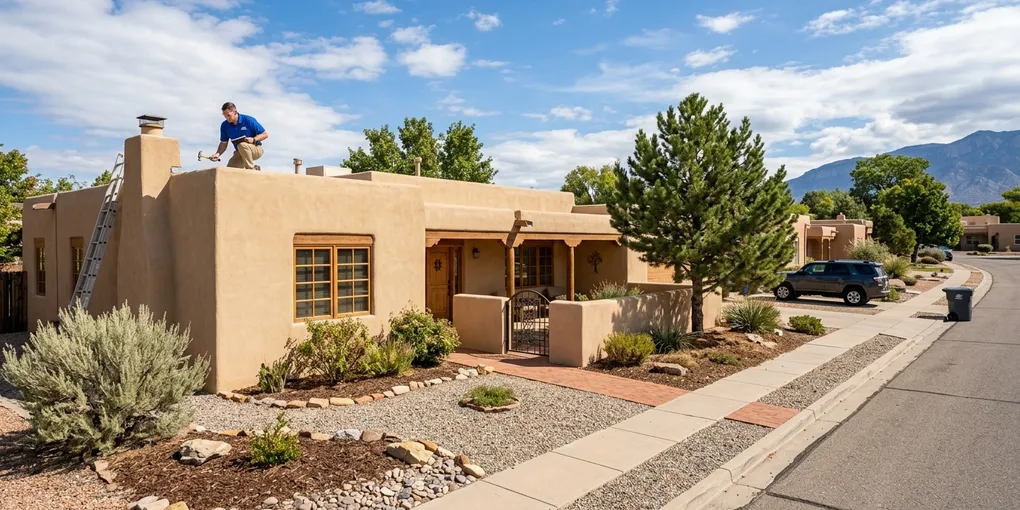
The Ultimate Guide to Spotting Roof Damage in Albuquerque Real Estate Disclosures
Albuquerque’s real estate market offers an authentic Southwestern lifestyle framed by the breathtaking backdrop of the Sandia Mountains and the historic Rio Grande Valley. Whether you are falling in love with a historic Pueblo Revival or Territorial-style home with exposed wooden vigas in Nob Hill or Old Town, a sprawling adobe hacienda in the lush North Valley or Corrales, or a modern foothill residence in Sandia Heights, buying a home in the Duke City is an extraordinary opportunity.
However, beneath Albuquerque’s iconic parapet walls and sun-drenched stucco facades lies a persistent structural vulnerability: New Mexico’s high-altitude climate is notoriously brutal on flat and low-slope roofing systems.
Sitting at an elevation of more than 5,300 feet, Albuquerque receives intense ultraviolet (UV) radiation that deteriorates roofing membranes at nearly double the rate of sea-level cities. Combined with dramatic day-to-night temperature swings, fierce spring windstorms blowing grit off the Sandias, and violent summer monsoon cloudbursts that dump torrents of rain in minutes, Duke City roofs endure extreme environmental punishment. Because Southwestern architectural designs intentionally hide the roof surface behind raised parapets, catastrophic roofing failure is frequently invisible from the street.
As a practicing New Mexico real estate attorney and active Albuquerque broker, I routinely see homebuyers face staggering repair bills because they misunderstood flat roof engineering and failed to spot subtle red flags on the seller’s property disclosure. In this comprehensive guide, we dissect the mechanics of high-desert roof breakdown, examine New Mexico disclosure statutes and NMAR forms, and show you exactly how to protect your investment during the due diligence period.
The Engineering of High-Desert Roof Degradation in Bernalillo County
To properly inspect an Albuquerque home, you must understand the materials engineered for flat and low-slope architecture and the unique meteorological forces that degrade them.
High-Altitude UV Baking and Elastomeric Coating Decay
Albuquerque enjoys more than 310 sunny days per year. At over a mile above sea level, thin atmosphere allows high levels of ultraviolet radiation to strike roof surfaces:
- Sprayed Polyurethane Foam (SPF) Roofs: SPF is one of the most common roofing systems in Albuquerque, prized for its seamless insulating qualities. However, raw polyurethane foam degrades rapidly when exposed to sunlight. It relies completely on an elastomeric protective topcoat (acrylic or silicone). If this elastomeric coating is not pressure-washed and professionally recoated every 5 to 7 years, UV rays turn the foam into a powdery, crumbly substance known as “foam chalking.” Once the coating fails, birds peck into the foam, hail creates pockmarks, and rainwater saturates the entire insulation layer like a sponge.
- Modified Bitumen and Tar-and-Gravel: Traditional asphalt-based built-up roofs (BUR) and torch-down modified bitumen membranes suffer from thermal shock. Under 100°F summer sun, roof surfaces reach 150°F, only to drop 40°F when evening mountain breezes sweep down the Sandias. This rapid contraction causes brittle asphalt to fissure, crack, and separate around edges.
The Pueblo Parapet and Canale Drainage Bottleneck
The defining aesthetic of Southwestern architecture is the raised parapet wall, which completely conceals the flat roof from view:
- The Canale Vulnerability: Instead of perimeter eaves and gutters, Albuquerque flat roofs channel water through canales—spouts cut directly through exterior parapet walls. In autumn and spring, blowing leaves, cottonwood seeds, and desert debris accumulate around canale openings. When violent July monsoons strike, clogged canales prevent drainage, causing water to pool 4 to 8 inches deep behind parapets.
- Hydrostatic Parapet Leaks: Flat roofs are designed to shed water toward drains, not act as swimming pools. Prolonged ponding water exerts hydrostatic pressure that pushes moisture beneath flashings. Even worse, water penetrates behind the exterior stucco of the parapet wall, saturating adobe bricks or wood framing and causing massive stucco delamination and interior wall rot.
Exposed Vigas and Latillas: Historic Wood Penetrations
In authentic Pueblo and Territorial homes, exterior wooden roof beams (vigas) project through the exterior stucco walls just below the roofline:
- Viga Cap Rot: The tops of projecting vigas are directly exposed to rain, snow, and relentless sun. If metal flashing caps or elastomeric seals over viga penetrations crack, moisture wicks directly into the interior structural timbers. Once rot begins inside a load-bearing viga, replacing the beam requires dismantling portions of the roof and exterior masonry walls.
Tired of manually reading 200-page disclosures?
Let DisclosurePro AI scan your documents for hidden termite damage, structural issues, and unpermitted work in 10 seconds. Try it free today.
New Mexico Real Estate Disclosure Laws: NMAR Form 2301 Explained
New Mexico law requires sellers to disclose known material defects, but the practical execution of these laws often leaves buyers exposed if they don’t scrutinize the paperwork.
The New Mexico Association of REALTORS® (NMAR) Property Disclosure
In standard residential transactions across New Mexico, sellers complete the NMAR Form 2301 (Seller’s Property Disclosure):
- Section 2 – Roof and Roof Covering: The seller must affirmatively identify the type of roof covering (e.g., Brai/torch-down, foam, asphalt shingle, tile, metal), disclose its approximate age, and state the date the roof was last recoated.
- Leaks and Repairs: The seller is required to disclose whether there are any past or present leaks, whether repairs have been performed during their ownership, and whether any transferable warranties exist.
- Water Intrusion and Drainage: The seller must state if the property experiences water ponding on the roof or drainage issues surrounding canales, scuppers, or parapet walls.
The “Actual Knowledge” Legal Standard
Under New Mexico common law and state licensing rules, a seller is legally obligated to disclose known material adverse facts and latent defects that would not be readily apparent to a reasonably prudent buyer.
However, sellers are only bound by their actual knowledge:
- If an out-of-state investor or flipper acquires a property in Albuquerque’s East Gateway or Westside and paints the interior, they routinely check “Do Not Know” across the disclosure statement.
- Furthermore, many sellers believe that applying a fresh DIY bucket of white elastomeric coating “fixes” a leak. They check “No known leaks,” reasoning that the fresh paint resolved the issue, while failing to disclose that the roof decking beneath is waterlogged and rotted.
Evasive Phrasing in Albuquerque Seller Disclosures
When reviewing NMAR Form 2301 in the Albuquerque market, beware of these common euphemisms:
- “Flat roof professionally recoated in 2024” — Often conceals that the roofer warned the underlying foam was saturated and only an unbonded maintenance coat was applied.
- “Canales cleaned regularly; normal ponding observed” — Minimizes severe drainage slope failure where standing water remains for weeks after storms.
- “Vigas sealed and treated annually” — Conceals that water is actively migrating down interior beam penetrations into the ceiling plaster.
- “Roof warranty in place” — Sounds reassuring, but most roof warranties in New Mexico are non-transferable or require a formal inspection and transfer fee within 30 days of closing that sellers fail to coordinate.
The Manual Review Problem: Navigating the Albuquerque Inspection Window
In the standard New Mexico Residential Purchase Agreement, buyers typically negotiate an Inspection Contingency period of 10 to 15 calendar days (often compressed to 7 days in fast-moving market segments).
During this window, a buyer must thoroughly evaluate:
- The multi-page NMAR Seller’s Property Disclosure Statement.
- The 60-to-80-page general home inspection report with thermal imaging scans.
- City of Albuquerque Planning Department or Bernalillo County permit records to verify whether reroofing permits were pulled and final inspections passed.
- Existing roof maintenance logs, elastomeric warranty certificates, and contractor invoices.
- Historic district guidelines if purchasing within the Old Town Historic Zone or Huning Highland Historic Overlay.
Because Albuquerque flat roofs cannot be seen from the street, and general home inspectors often disclaim foam roofs—stating: “Walking on foam roofs can puncture delicate elastomeric membranes; visual inspection conducted from ladder at parapet edge only”—critical moisture pockets are frequently overlooked. A homebuyer skimming through dozens of disclosure pages can easily miss that a foam roof has passed its recoat deadline by four years.
Financial Impact: A Real-World Nob Hill Pueblo Revival Case Study
To understand the severe financial risks of an overlooked roof disclosure, consider this realistic scenario from a purchase in Albuquerque’s historic Nob Hill neighborhood.
The Acquisition
Carlos and Elena purchased a charming 1938 Pueblo Revival adobe home in Nob Hill for $495,000. The property featured classic Southwestern architecture: earth-toned parapets, rounded corners, protruding wooden vigas, and an inviting rooftop patio deck.
On the NMAR Form 2301 disclosure, the seller marked the roof as “Sprayed Polyurethane Foam,” indicated it had been “recoated in spring 2024,” and checked “No” to active leaks. The general home inspector inspected the roof from an eave ladder, noting: “Foam roof appears white and evenly coated; no active water staining detected on tongue-and-groove ceilings.” Reassured, Carlos and Elena closed on the property.
The Monsoon Disaster
Three months later, a violent North American Monsoon storm parked over the Sandia foothills, unleashing 2.2 inches of torrential rain in under 90 minutes.
Within an hour, water began dripping from the tips of the interior ceiling vigas in the living room and formal dining room. Carlos went onto the roof and discovered that the two primary canales were completely submerged under four inches of standing water.
A licensed New Mexico commercial roofing contractor performed an infrared thermal moisture scan the following morning and revealed catastrophic hidden damage:
- The seller’s “2024 recoat” had been an amateur single-coat acrylic application rolled directly over bird-pecked, wet foam without scraping degraded material or allowing moisture to dry.
- The flat roof deck had settled over 80 years, creating a major depression that directed water away from the canales rather than toward them.
- Ponding water had seeped behind the parapet stucco, soaking the adobe brick walls and causing exterior stucco to bubble and crack.
- Moisture trapped beneath the foam had rotted the tongue-and-groove fir ceiling decking and compromised the bearing ends of two main structural pine vigas.
The Financial Devastation
Because the seller claimed they had hired an independent handyman in good faith, proving fraudulent concealment in court was cost-prohibitive. Carlos and Elena had to fund the total reconstruction out-of-pocket:
| Expense Item | Cost |
|---|---|
| Complete scarification and tear-off of waterlogged foam down to wood decking | $7,400 |
| Replacement of rotted tongue-and-groove pine roof decking sheathing | $6,200 |
| Structural reinforcement and epoxy stabilization of compromised timber vigas | $8,500 |
| Installation of 3-inch 3-lb density SPF roof system with tapered drainage crickets | $12,800 |
| Application of premium 100% silicone high-solids UV protective coating (15-year system) | $4,200 |
| Parapet wall stucco repair, elastomeric recoating, and enlarged copper canale liners | $4,800 |
| City of Albuquerque residential re-roofing and structural building permits | $900 |
| Total Devastation | $44,800 |
Frequently Asked Questions about Roof Issues in Albuquerque
1. How often does a flat roof need to be recoated in Albuquerque?
In Albuquerque’s high-UV climate:
- Acrylic Elastomeric Coatings: Must be pressure-washed, inspected, and recoated every 5 to 7 years. Waiting longer allows UV rays to burn through the coating into the underlying foam or bitumen.
- 100% High-Solids Silicone Coatings: More durable and moisture-resistant than acrylics, silicone coatings typically last 10 to 15 years before requiring reapplication.
2. Can you walk on a foam roof in Albuquerque without damaging it?
You can walk on a sprayed polyurethane foam (SPF) roof, but you must do so with extreme caution. Always wear soft-soled shoes and avoid sharp turns or heavy foot impact. Walking with high heels, dropping tools, or dragging patio furniture across foam easily punctures the elastomeric membrane, allowing water and UV rays to destroy the foam beneath.
3. What are canales, and why do they cause roof leaks in Albuquerque?
Canales are traditional Southwestern scuppers or drainage troughs cut through parapet walls that allow rainwater to drain from flat roofs into exterior yards or rain barrels. Because they penetrate exterior walls, the metal or membrane flashing surrounding the canale is a prime point of failure. If canales are undersized, improperly sloped, or clogged with debris, water backs up behind the parapet and penetrates the building envelope.
4. What is a “roof cricket” and does my Albuquerque flat roof need one?
A roof cricket is a peaked or tapered saddle structure built onto a flat roof to divert water away from flat spots, parapet corners, and chimneys toward drainage canales. Because older Albuquerque homes experience natural structural settling, building tapered crickets during a reroof is essential to eliminate chronic water ponding.